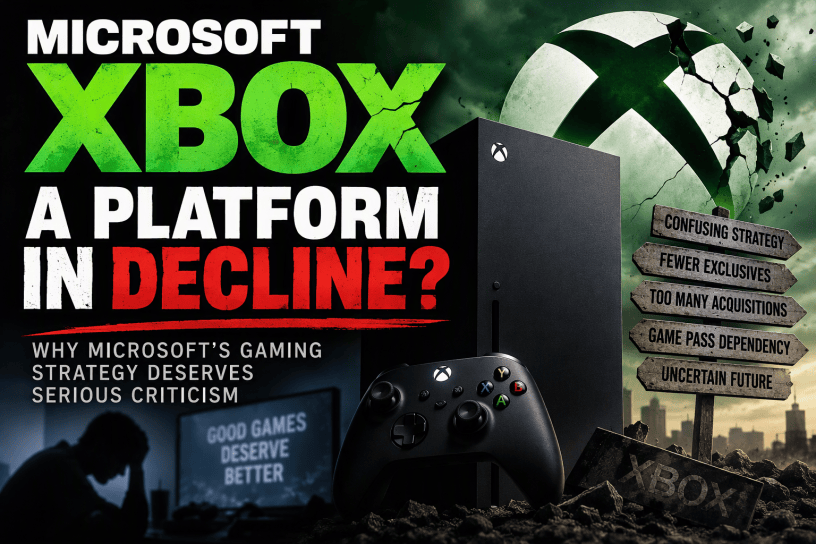
For more than two decades, Xbox has been one of the most recognizable brands in gaming. When Microsoft entered the console market in 2001, it challenged established giants with powerful hardware, ambitious online services, and a willingness to take risks. The original Xbox introduced players to Halo. The Xbox 360 helped define online console gaming. Xbox Live became the gold standard for multiplayer services.
Yet despite these achievements, modern Xbox increasingly feels like a brand struggling with its identity. While Microsoft remains one of the largest and wealthiest technology companies in the world, Xbox has spent much of the past decade making strategic decisions that have left both loyal fans and industry observers questioning its direction.
This article examines some of the most significant criticisms of Xbox today, ranging from inconsistent exclusives and confusing messaging to hardware challenges and a growing sense that the console itself is becoming an afterthought.
The Identity Crisis of Modern Xbox
One of Xbox’s biggest problems is that it no longer seems clear what Xbox actually is.
Historically, console brands had straightforward value propositions. Nintendo offered family-friendly innovation and beloved franchises. PlayStation delivered blockbuster exclusives and strong third-party support. Xbox focused on powerful hardware, online gaming, and flagship franchises such as Halo, Gears of War, and Forza.
Today, Microsoft often presents Xbox as simultaneously:
- A console
- A PC platform
- A cloud service
- A subscription service
- A mobile gaming ecosystem
- A publisher of games on competing platforms
While diversification can be beneficial, Xbox’s messaging frequently creates confusion. If every device is an Xbox, then what is the purpose of buying an Xbox console?
Consumers generally prefer simple value propositions. Unfortunately, Microsoft has spent years promoting an ecosystem so broad that the hardware itself often feels secondary.
The result is a brand that sometimes appears uncertain whether it wants to sell consoles, subscriptions, cloud access, or software.
The Decline of Console Exclusivity
Exclusive games have historically driven gaming hardware sales.
Nintendo has Mario, Zelda, and Pokémon. Sony has franchises such as God of War, Spider-Man, The Last of Us, and Ghost of Tsushima.
Xbox once had a comparable lineup. During the Xbox 360 era, Microsoft aggressively invested in exclusive experiences that gave players reasons to choose its platform.
That advantage has weakened considerably.
Microsoft’s strategy increasingly emphasizes releasing games across PC and, more recently, across competing platforms. While this may maximize software revenue, it raises a fundamental question: why buy Xbox hardware at all?
The issue is not necessarily that games are available elsewhere. Many players welcome broader availability. The problem is that Microsoft simultaneously asks consumers to invest in an Xbox platform while reducing the number of compelling reasons to do so.
When platform exclusivity becomes less important, console differentiation becomes more difficult. Xbox risks becoming less of a destination and more of a delivery method.
Halo: A Symbol of Lost Momentum
It is impossible to discuss criticism of Xbox without discussing Halo.
For many gamers, Halo was Xbox.
The franchise helped launch the original Xbox, drove sales of the Xbox 360, and established Xbox Live as a revolutionary online service.
However, the series has struggled to maintain the cultural dominance it once enjoyed.
While opinions differ on individual entries, many fans believe that the franchise has spent years searching for a consistent direction. Reboots, narrative shifts, controversial multiplayer decisions, delayed content, and changing development priorities have contributed to a perception that Microsoft has never fully figured out how to modernize its flagship series.
A healthy platform needs flagship franchises that generate excitement and define its identity.
When its most iconic property generates debates about missed potential rather than industry leadership, that reflects poorly on the broader platform strategy.
Too Many Acquisitions, Too Few Results
Microsoft has spent enormous sums acquiring game studios and publishers.
In theory, this strategy should have transformed Xbox into a powerhouse of exclusive content.
Instead, critics argue that the results have often arrived too slowly.
Large acquisitions generate headlines and investor interest, but players ultimately care about games. For years, Xbox repeatedly emphasized future potential:
- Upcoming projects
- Newly acquired studios
- Long-term roadmaps
- Future ecosystems
What many consumers wanted was a steady stream of exceptional releases in the present.
Some acquired studios have produced excellent games, but the overall perception persists that Microsoft has been better at purchasing talent than showcasing the results of those purchases.
Acquisitions are not substitutes for execution. Buying studios may solve content shortages on paper, but it does not automatically produce critically acclaimed games or stronger platform identity.
The Problem with Game Pass Dependency
Game Pass is widely praised and often described as one of the best deals in gaming.
Yet even successful products can create problems.
Microsoft’s heavy emphasis on Game Pass has arguably reshaped how both consumers and developers think about game value. By conditioning players to expect large libraries for a monthly fee, the company risks reducing excitement around individual game launches.
There is also an ongoing debate about whether subscription models are sustainable for the broader gaming industry.
A subscription service works best when there is a constant flow of new content. That creates pressure to prioritize quantity alongside quality.
Critics argue that Xbox sometimes promotes the size of its library more aggressively than the uniqueness of the games within it.
This can lead to the perception that Xbox’s primary selling point is access rather than excellence.
Consumers may enjoy Game Pass while simultaneously feeling less attached to the Xbox brand itself.
Hardware Leadership That Rarely Matters
Microsoft frequently highlights the technical capabilities of Xbox hardware.
The Xbox Series X launched with impressive specifications and was widely regarded as one of the most powerful consoles ever released.
However, superior specifications do not automatically translate into market leadership.
Gaming history is filled with examples where the most technically advanced platform failed to dominate.
The problem for Xbox is that power alone is rarely enough to motivate purchases.
Most players care about:
- Games
- Friends
- Communities
- Convenience
- Price
Raw performance usually ranks lower on the list.
Microsoft’s marketing often emphasizes technical achievements that average players either do not notice or do not consider decisive. A slightly sharper image or higher frame rate matters far less than a must-play exclusive.
As a result, Xbox sometimes appears to be winning hardware comparisons while losing broader cultural relevance.
Cloud Gaming: A Vision Still Waiting for Adoption
Microsoft has spent years promoting cloud gaming as a major pillar of Xbox’s future.
The concept is compelling. Play high-end games on a variety of devices without expensive hardware.
The reality has been more complicated.
Cloud gaming faces challenges involving:
- Internet quality
- Latency
- Data limits
- Consumer habits
- Infrastructure costs
Many players still prefer local hardware because it provides consistency and reliability that streaming struggles to match.
Microsoft’s enthusiasm for cloud gaming sometimes feels disconnected from actual consumer demand. While cloud technology has improved significantly, it has not yet become the transformative force that many early advocates predicted.
The danger is that Xbox may devote excessive attention to future possibilities while neglecting current strengths.
Weak Global Positioning
Xbox remains significantly weaker than its major competitors in several international markets.
While the brand enjoys strong recognition in North America, its position elsewhere is often less secure.
Certain regions have remained difficult markets for Xbox despite years of effort. Competitors have built stronger local relationships, cultural relevance, and retail presence.
This matters because global scale is increasingly important in gaming.
A platform that struggles to gain traction internationally faces challenges in:
- Market share growth
- Brand awareness
- Developer support
- Ecosystem expansion
Microsoft has invested heavily in improving Xbox’s global footprint, but the results have often fallen short of expectations.
Constant Strategic Shifts
Perhaps the most common criticism of Xbox is inconsistency.
Over the years, Microsoft has repeatedly shifted priorities:
- Kinect
- TV integration
- Entertainment services
- Cloud gaming
- Subscription gaming
- Platform ecosystems
- Publisher expansion
Some degree of adaptation is inevitable in technology markets.
However, constant strategic changes can create uncertainty.
Fans often struggle to determine Microsoft’s long-term vision because that vision seems to evolve every few years.
When strategy changes frequently, consumers become hesitant to fully commit. Developers may also question whether today’s priorities will remain relevant tomorrow.
Strong brands are built through consistent execution over long periods of time.
Xbox has often appeared to be searching for the next strategy before fully committing to the current one.
The Risk of Becoming “Just Another Publisher”
A growing concern among critics is that Microsoft’s current trajectory could eventually diminish the importance of Xbox hardware altogether.
As more Xbox games appear on multiple platforms, the distinction between Xbox as a console brand and Microsoft as a publisher becomes increasingly blurred.
From a financial perspective, this may be sensible. Selling games everywhere increases potential revenue.
But from a branding perspective, it creates challenges.
Historically, console manufacturers succeeded because their hardware offered unique experiences unavailable elsewhere.
If Xbox evolves primarily into a software publisher, then its console business risks becoming less relevant over time.
That may ultimately be Microsoft’s intention. If so, it represents one of the most dramatic transformations in gaming history.
Yet it also raises questions about what devoted Xbox console owners gain from supporting a platform whose exclusivity advantages are steadily diminishing.
Conclusion
Microsoft’s Xbox division is not a failure. It remains influential, technologically sophisticated, and financially backed by one of the world’s largest corporations. Game Pass is genuinely innovative. Xbox services are often excellent. The company owns an enormous portfolio of gaming franchises.
The criticism comes precisely because expectations are so high.
Many observers see a company with extraordinary resources that has not consistently translated those resources into market leadership, cultural dominance, or a clear platform identity. Xbox has spent years investing in future opportunities while sometimes struggling to deliver the defining experiences that make a gaming ecosystem feel indispensable.
The modern Xbox strategy may ultimately prove successful. Microsoft is betting on a future where platforms matter less than ecosystems, subscriptions, and accessibility. That future may arrive.
But until it does, Xbox remains vulnerable to a central criticism: despite its immense strengths, it often feels like a brand that knows what it wants to become, yet still struggles to explain why players should choose it today.

