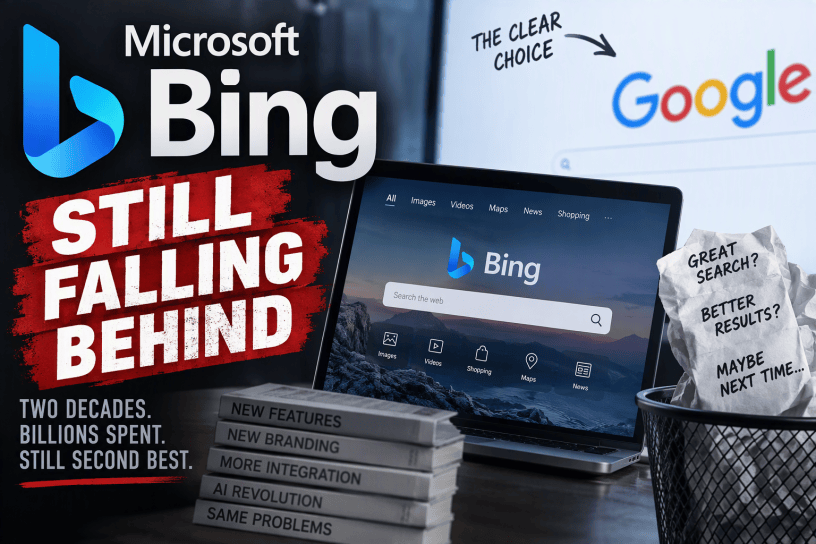
Two Decades of Chasing Google and Still Falling Behind
When Microsoft launched Bing in 2009, it was supposed to be different. It was not merely another search engine. It was marketed as a “decision engine,” a smarter way to find information, shop online, plan travel, and navigate the web. Backed by one of the largest technology companies in the world and integrated into the Windows ecosystem, Bing appeared to have every possible advantage.
Seventeen years later, however, Bing remains one of Microsoft’s most persistent disappointments.
Despite billions of dollars in investment, endless marketing campaigns, strategic partnerships, browser integrations, operating system bundling, AI initiatives, and repeated rebranding efforts, Bing continues to occupy the shadow cast by Google. It has become the technology equivalent of a runner permanently stuck in second place, except the race often resembles a distant pursuit rather than genuine competition.
The story of Bing is not simply about market share. It is about a product that has struggled for years to establish a clear identity, deliver consistently superior experiences, or convince users to switch voluntarily.
A Search Engine Few People Actively Choose
Perhaps the most damaging criticism of Bing is that many of its users arrive there accidentally.
Countless users encounter Bing because it is the default search option in Microsoft Edge, because Windows routes certain searches through Bing, or because changing defaults requires effort many casual users never bother to expend.
This creates a perception problem that Microsoft has never fully overcome.
Successful consumer products generally attract users because they are considered the best solution available. Bing often appears to gain users because it is already installed. That distinction matters.
If people must be nudged, guided, or defaulted into using a product, that raises an uncomfortable question: would they choose it otherwise?
For much of Bing’s existence, the answer has often appeared to be no.
The Identity Crisis That Never Ends
What exactly is Bing supposed to be?
Over the years Microsoft has repeatedly shifted the platform’s messaging.
Sometimes Bing is presented as a traditional search engine.
Sometimes it is an AI assistant.
Sometimes it is a shopping engine.
Sometimes it is a rewards platform.
Sometimes it is a travel tool.
Sometimes it is part of a larger Microsoft ecosystem.
The constant reinvention reflects a deeper issue. Bing has spent much of its existence defining itself relative to competitors instead of establishing a unique, compelling purpose of its own.
A successful product usually has a stable value proposition.
Google searches information.
YouTube delivers video.
Spotify streams music.
Bing often seems uncertain about what role it ultimately wants to play.
Search Quality Remains a Frequent Complaint
Search quality is the foundation of any search engine.
Nothing matters more.
Users can forgive a mediocre interface. They can tolerate odd design decisions. They can overlook branding issues.
What they cannot tolerate is poor search relevance.
For years, Bing has faced criticism from users who claim it produces less useful results than Google’s search engine in numerous categories. While experiences vary from user to user, the perception gap has proven remarkably difficult to close.
The challenge is particularly evident in highly technical searches.
Developers, researchers, IT professionals, and students often rely on precise search results to locate documentation, troubleshooting guides, academic resources, and niche content.
When users repeatedly find themselves adding phrases like “Google this instead” or immediately switching search engines after an unsuccessful query, confidence erodes quickly.
A search engine lives and dies based on trust. Once users believe another platform consistently performs better, winning them back becomes incredibly difficult.
Microsoft’s Dependency on Forced Exposure
One of the most common criticisms directed at Bing involves Microsoft’s reliance on platform integration.
Windows pushes Bing.
Edge promotes Bing.
Various Microsoft services encourage Bing.
Widgets connect to Bing.
Start menus connect to Bing.
System searches connect to Bing.
Rather than creating an irresistible product experience, Microsoft often appears focused on maximizing exposure opportunities.
To critics, this suggests that Microsoft’s confidence lies more in distribution than product superiority.
Imagine if the primary strategy for increasing a restaurant’s popularity involved forcing everyone entering a shopping mall to walk past the front door.
That may increase traffic, but it does not automatically improve the food.
The same logic applies to search.
Visibility is useful, but users ultimately stay because they find value.
The Endless Market Share Problem
No discussion of Bing can avoid its long-running market share difficulties.
Year after year, Bing remains far behind Google globally.
The exact percentages fluctuate over time, but the broader narrative rarely changes.
Google dominates.
Bing trails.
Microsoft introduces new features.
Google remains dominant.
Microsoft launches another initiative.
Google remains dominant.
The cycle repeats.
This reality creates another problem. Search engines benefit from network effects, behavioral data, and user feedback at enormous scale.
The larger the user base, the more opportunities exist to refine systems, understand trends, and improve relevance.
Google’s massive scale gives it advantages that become increasingly difficult for competitors to overcome.
As a result, Bing often seems trapped in a perpetual catch-up game.
AI Is Not a Magic Fix
The arrival of generative AI created what many observers viewed as Bing’s biggest opportunity in years.
Microsoft integrated advanced AI capabilities directly into Bing and gained significant media attention.
Suddenly people were talking about Bing again.
Unfortunately for Microsoft, publicity does not automatically translate into long-term adoption.
Many users experimented with AI-powered Bing features during the initial excitement period. A significant number then returned to their previous habits.
This reflects a broader reality about technology adoption.
People generally do not switch products simply because a new feature exists.
They switch because the overall experience becomes meaningfully better.
AI may generate summaries, answer questions, and create content, but if users still prefer another search engine for day-to-day information retrieval, the fundamental competitive challenge remains unresolved.
The addition of AI can enhance a product, but it cannot automatically solve years of accumulated market positioning problems.
Feature Bloat Instead of Simplicity
Modern Bing sometimes feels less like a search engine and more like a portal stuffed with features.
News feeds.
Shopping suggestions.
Rewards promotions.
AI panels.
Trending stories.
Sidebars.
Suggestions.
Recommendations.
Various widgets compete for attention simultaneously.
The result can feel cluttered.
Google’s homepage became famous largely because of its simplicity. Users saw a search box and little else.
Bing, by contrast, frequently resembles a digital billboard.
While some users appreciate additional functionality, others view it as unnecessary noise surrounding the primary task of searching for information.
A search engine should excel first at search.
Everything else should be secondary.
Too often Bing seems eager to emphasize secondary features.
The Rewards Program Problem
Microsoft Rewards is often cited as one of Bing’s most successful user acquisition tools.
Users can earn points through searches and other activities.
While effective in driving engagement, the program also creates an uncomfortable perception.
Critics argue that a truly competitive search engine should attract users because of search quality, not because users are being compensated with points and incentives.
When rewards become one of the product’s strongest selling points, it invites questions about whether the underlying service is compelling enough on its own merits.
The existence of Rewards is not inherently problematic.
The fact that it frequently appears among the first arguments in favor of Bing is more revealing.
A History of Rebranding Without Reinvention
Microsoft has repeatedly refreshed Bing’s image.
New logos.
New interfaces.
New marketing campaigns.
New positioning statements.
New AI branding.
Yet many of the underlying criticisms remain remarkably consistent.
This highlights a classic technology industry mistake.
Companies often confuse visible change with meaningful change.
Updating a logo is easy.
Changing consumer perception is hard.
For Bing, the challenge has never been branding.
It has been persuading users that it delivers a clearly superior experience.
Without solving that core issue, cosmetic changes inevitably fall short.
The Shadow of Google’s Reputation
Even if Bing matched Google feature for feature tomorrow, Microsoft would still face a tremendous obstacle: public perception.
For many internet users, “Google” has become synonymous with searching the web.
The company’s brand has become a verb.
People say they are going to “Google” something.
Very few people say they are going to “Bing” something.
That linguistic reality reveals just how deeply Google has embedded itself into internet culture.
Microsoft is not merely competing against a search engine.
It is competing against decades of habit.
Against default behaviors.
Against cultural momentum.
Against one of the strongest brands ever built.
Bing has spent much of its life fighting uphill against this reality, and progress has often been frustratingly limited.
Why Bing Matters Anyway
Ironically, Bing’s greatest significance may be its existence rather than its excellence.
Without Bing, Google’s dominance in search would be even greater.
Competition matters.
Alternative search engines matter.
A healthy technology ecosystem benefits when multiple companies compete for users.
Bing undoubtedly pressures Google to improve products, introduce new features, and respond to challenges.
The problem is that being an important competitor is not the same thing as being a great product.
Microsoft deserves credit for maintaining a serious search platform despite years of difficult competition.
What it does not necessarily deserve is praise for the results.
Conclusion: A Search Engine That Never Reached Its Potential
Bing is not a failure in the traditional sense.
It serves millions of users.
It powers numerous Microsoft services.
It generates revenue.
It continues to evolve.
Yet measured against Microsoft’s resources, ambitions, and decades of investment, Bing remains one of the company’s most underwhelming products.
The search engine has spent years chasing Google without ever truly escaping its rival’s shadow.
It has relied heavily on ecosystem integration, incentives, and marketing campaigns while struggling to create a compelling reason for users to switch voluntarily.
The introduction of AI generated excitement, but excitement alone is not enough. A product’s success ultimately depends on whether people choose it when alternatives exist.
That has always been Bing’s central challenge.
For nearly two decades, Microsoft has asked the internet to reconsider Bing.
The internet’s answer has largely remained the same.
People will use Bing when it is presented to them.
Many still do not actively seek it out.
And that may be the most damning criticism of all.

