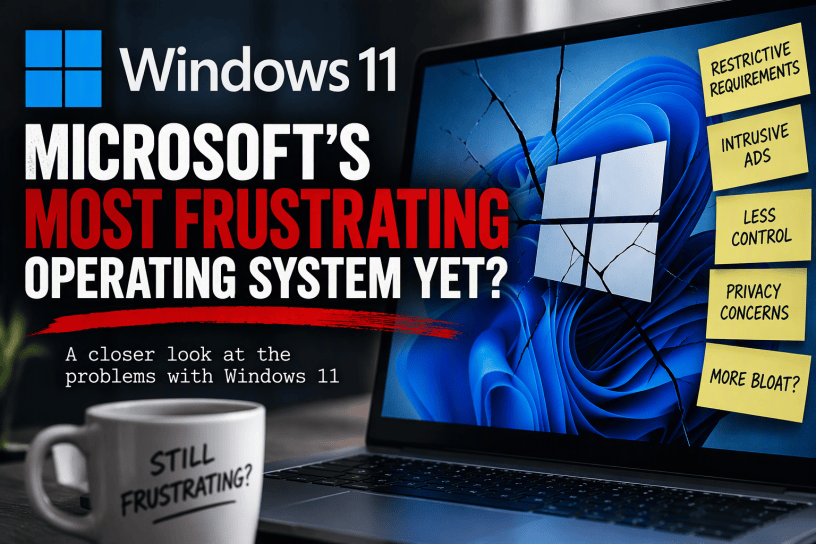
When Microsoft unveiled Windows 11, the company presented it as a modern, streamlined evolution of the Windows experience. A redesigned interface, improved productivity features, stronger security requirements, and deeper integration with Microsoft’s ecosystem were positioned as major advantages. On paper, it looked like a significant step forward.
Yet years after its release, Windows 11 remains one of the most divisive versions of Windows ever created. While some users appreciate its visual refresh and new capabilities, many others see it as an operating system that prioritizes Microsoft’s goals over user needs. From questionable hardware requirements to intrusive advertising, inconsistent design choices, and reduced customization, Windows 11 often feels less like a tool built for users and more like a platform designed to guide them toward Microsoft’s preferred services.
The problem is not that Windows 11 lacks good ideas. Rather, it is that its strengths are frequently overshadowed by decisions that make the operating system feel restrictive, inconsistent, and unnecessarily complicated.
The Hardware Requirement Controversy
Perhaps no aspect of Windows 11 generated more backlash than its hardware requirements.
Traditionally, Windows updates aimed to bring new features to as many existing PCs as possible. Windows 11 took a different approach. Millions of perfectly functional computers were declared incompatible because they lacked specific features such as TPM 2.0 support or approved processors.
Microsoft justified these requirements by emphasizing security and reliability. While enhanced security is certainly important, many users struggled to understand why systems capable of running demanding software, modern games, and Windows 10 smoothly were suddenly considered obsolete.
The result was widespread confusion and frustration. Consumers who purchased premium computers only a few years earlier discovered that their devices were not officially supported. Businesses faced difficult upgrade decisions. Environmentally conscious users questioned why working hardware was effectively being pushed toward retirement.
The issue was not simply about technical requirements. It was about trust. People expect their computers to remain useful for a reasonable period of time, and Windows 11 gave many users the impression that Microsoft was shortening that lifecycle.
A User Interface That Values Appearance Over Efficiency
Windows 11 undeniably looks modern. Rounded corners, updated icons, improved animations, and cleaner menus create a more polished appearance than Windows 10.
However, visual appeal does not always translate into better usability.
The centered taskbar became one of the operating system’s defining changes. While it may resemble designs found on other platforms, many longtime Windows users found it less practical than the traditional left-aligned layout. Although the alignment can be changed, the decision reflects a broader trend in Windows 11: prioritizing aesthetics over established workflows.
More problematic is the reduction of user control.
Features that once required a simple right-click often became hidden behind additional menus. The “Show More Options” context menu is perhaps the most obvious example. Tasks that previously took one click may now require two or more. Individually, these changes seem minor. Collectively, they create friction that power users encounter dozens or even hundreds of times per day.
Good design should reduce complexity. Too often, Windows 11 merely relocates it.
The Never-Ending Problem of Inconsistency
One of the most common criticisms of Windows has persisted for decades: inconsistency.
Windows 11 was marketed as an opportunity to modernize and unify the operating system. Yet even today, it remains a patchwork of old and new design philosophies.
Users can encounter modern settings pages alongside legacy control panels. Some interfaces follow the new visual language while others appear largely unchanged from earlier Windows releases. Dialog boxes from years past sit only a few clicks away from newly redesigned menus.
This creates a strange experience where the operating system feels unfinished.
For a company with Microsoft’s resources, many users expected Windows 11 to finally eliminate the fragmentation that has characterized Windows for years. Instead, the operating system often feels like multiple generations of Windows stitched together under a more attractive visual layer.
The result is a platform that can appear polished at first glance but reveals increasing complexity the deeper users explore.
Advertising Has No Place in an Operating System
Perhaps the most controversial aspect of modern Windows is the increasing presence of promotional content.
An operating system is not a social media platform. It is not a streaming service. It is not an online marketplace. Most people purchase a computer expecting the operating system to function as a neutral tool.
Windows 11 frequently challenges that expectation.
Users regularly encounter prompts encouraging them to use Microsoft accounts, subscribe to Microsoft 365, back up data with OneDrive, switch browsers, or try various Microsoft services. While these recommendations can occasionally be useful, many users view them as advertisements embedded within software they already paid for.
The Start menu sometimes highlights recommended content. Setup processes encourage deeper engagement with Microsoft’s ecosystem. Notifications may promote features or services that users never requested.
Individually, none of these prompts is particularly severe. Together, they contribute to a growing perception that Windows is increasingly promotional.
The fundamental question is simple: should a paid operating system constantly market additional products to its users?
Many would argue the answer is no.
The Microsoft Account Push
Another major criticism of Windows 11 is its increasingly aggressive encouragement of Microsoft account usage.
Microsoft presents clear benefits for account-based setups. Cloud synchronization, password recovery, device management, and backup features become easier to use. These advantages are real and should not be dismissed.
The problem emerges when users prefer a different approach.
For decades, local accounts represented a straightforward and private way to use Windows. Windows 11 has made that option more difficult to access, particularly during installation and initial setup.
Many users believe that choosing between a Microsoft account and a local account should be entirely voluntary. Instead, the setup experience often feels designed to steer users toward Microsoft’s preferred choice.
Critics see this as part of a broader trend in the technology industry where ownership is gradually being replaced by ecosystem participation.
The concern extends beyond convenience. It touches on questions of privacy, autonomy, and user control.
Feature Creep and Complexity
Windows has always attempted to serve a broad audience. Gamers, developers, students, businesses, and casual users all rely on the platform.
That flexibility is one of Windows’ greatest strengths.
It can also be one of its greatest weaknesses.
Windows 11 continues the longstanding pattern of accumulating features faster than it removes them. New tools, integrations, assistants, widgets, recommendations, and services appear regularly. While some users find these additions valuable, others feel overwhelmed by the growing complexity.
Many features exist because someone might use them, not because most people need them.
Over time, this contributes to a sense that Windows is becoming bloated. The operating system often feels less focused than competing platforms that prioritize simplicity and clarity.
More features do not automatically create a better product. Sometimes they simply create more settings, more menus, and more opportunities for confusion.
Updates That Interrupt Instead of Assist
Software updates are necessary. Security improvements, bug fixes, and performance enhancements help keep systems healthy.
Yet Windows has a long history of turning updates into a source of frustration.
Windows 11 has improved scheduling and update controls compared to some earlier Windows versions. Nevertheless, complaints remain common.
Unexpected restarts, lengthy installation periods, temporary performance issues, and occasional post-update bugs continue to generate criticism. Even when updates function correctly, many users dislike the feeling that significant system changes can arrive without their explicit consent.
The relationship between users and updates often feels paternalistic.
Microsoft knows systems need maintenance. Users understand that as well. The challenge lies in balancing security with control. Critics argue that Windows 11 still leans too heavily toward Microsoft’s priorities at the expense of user preference.
People want their computers to work for them, not the other way around.
Search Is Still Surprisingly Weak
In theory, Windows Search should be one of the operating system’s strongest features.
Users should be able to quickly locate files, settings, programs, and information. Instead, search frequently becomes a source of annoyance.
Sometimes results are inconsistent. Sometimes web suggestions dominate local content. Sometimes settings are harder to find than expected.
The situation becomes even more frustrating when search appears more interested in surfacing online content than delivering direct answers from the user’s own computer.
For a modern operating system, reliable search should be a solved problem.
The fact that many users still resort to manual navigation, third-party utilities, or workarounds speaks volumes about the limitations of Windows 11’s implementation.
The Privacy Question
Privacy remains a sensitive issue across the technology industry, and Microsoft is not immune to scrutiny.
Windows 11 collects diagnostic and telemetry data intended to improve system reliability and user experience. Microsoft provides controls and documentation explaining much of this behavior.
However, transparency does not automatically eliminate concern.
Many users remain uncomfortable with the amount of data modern operating systems collect. Others object to the complexity involved in understanding privacy settings.
The issue is less about any single data collection practice and more about perception.
When users feel uncertain about what information is being gathered and why, trust begins to erode. Trust is difficult to build and easy to lose.
For critics, Windows 11 symbolizes an era in which technology companies increasingly expect users to exchange personal data for convenience.
Windows 11 Often Feels Like a Service, Not a Product
Perhaps the strongest criticism of Windows 11 is philosophical rather than technical.
Historically, operating systems felt like products. Users purchased them, installed them, and largely controlled the experience.
Windows 11 reflects a broader industry shift toward services.
Cloud integration, subscription offerings, account requirements, ongoing feature experimentation, personalized recommendations, and ecosystem promotion all contribute to this transformation.
From Microsoft’s perspective, these changes create a connected, continuously evolving platform. From the perspective of many users, they create an environment where ownership feels increasingly limited.
The computer no longer feels entirely like their computer.
That perception may explain why Windows 11 generates such passionate criticism. The debate is not merely about taskbars, menus, or hardware requirements. It is about who ultimately controls the experience.
Conclusion: A Good Operating System With Too Many Self-Inflicted Problems
Windows 11 is not a failure.
It is stable for most users. It supports an enormous range of hardware and software. It remains the dominant desktop operating system in the world. It includes meaningful security improvements and useful productivity features.
Yet criticism persists because many of Windows 11’s shortcomings feel avoidable.
The strict hardware requirements alienated existing users. The interface sacrifices efficiency for visual presentation. Advertising and service promotion undermine trust. Inconsistent design continues to frustrate experienced users. Reduced customization leaves people feeling constrained. Privacy concerns remain unresolved.
The tragedy of Windows 11 is that underneath these issues lies a genuinely capable operating system.
Microsoft had an opportunity to create a version of Windows that combined modern design with user empowerment. Instead, Windows 11 often feels like an operating system caught between two competing goals: serving its users and serving Microsoft’s broader ecosystem strategy.
Until Microsoft places user choice, consistency, and control at the center of the Windows experience again, criticism of Windows 11 is unlikely to disappear. The operating system may look more modern than ever, but for many users, it represents a step away from the principles that made Windows successful in the first place.

