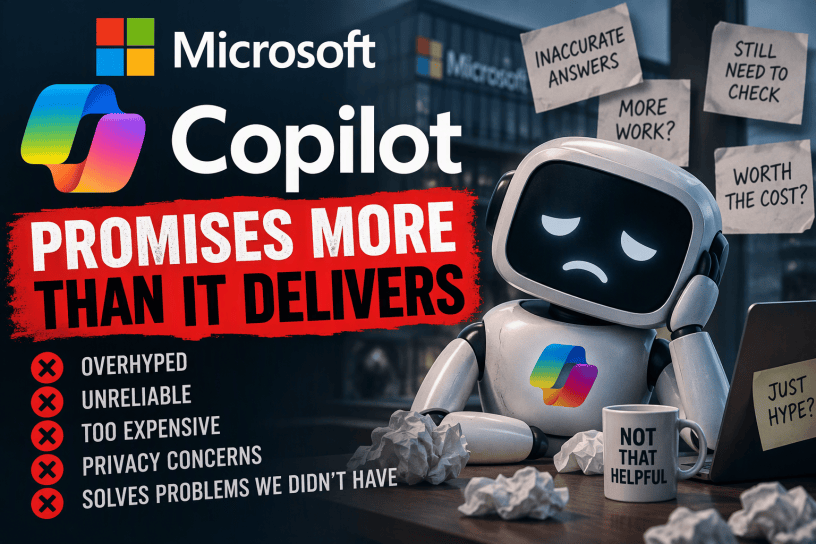
For the past several years, the technology industry has been racing to place artificial intelligence at the center of every product imaginable. Few companies have embraced this trend more aggressively than Microsoft, which has integrated its Copilot branding across Windows, Microsoft 365, GitHub, Edge, and numerous other services. The message is simple: AI is the future, and Copilot is the assistant that will transform how we work.
The marketing is compelling. The reality is far less impressive.
Despite Microsoft’s enormous investment in AI and its relentless promotion of Copilot, the product often feels like a solution in search of a problem. For many users, Copilot introduces complexity where simplicity previously existed, increases costs without delivering proportional value, and frequently falls short of the lofty promises made on its behalf.
The most significant issue with Microsoft Copilot is not that it fails completely. Rather, it succeeds just enough to generate excitement while failing often enough to create frustration. As a result, businesses and consumers are left trying to determine whether they are truly benefiting from AI assistance or simply adapting their workflows to accommodate the limitations of a technology that remains fundamentally unreliable.
The Hype Machine Is Working Overtime
One of the most frustrating aspects of Microsoft Copilot is the gap between marketing and reality.
Microsoft presents Copilot as a revolutionary productivity partner capable of saving time, reducing manual effort, and enabling users to accomplish more with less work. Product demonstrations often showcase ideal scenarios in which Copilot generates polished documents, summarizes meetings perfectly, produces accurate analyses, and responds intelligently to complex requests.
These demonstrations are undeniably impressive.
Unfortunately, carefully curated demonstrations are not the same as everyday usage.
Real-world users frequently discover that getting useful results requires extensive prompting, repeated corrections, and constant verification. A task that appears effortless in a keynote presentation can quickly turn into a tedious cycle of refining instructions, fact-checking outputs, and editing AI-generated content.
The irony is difficult to ignore. Copilot is marketed as a productivity tool intended to save time, yet many users spend significant time managing the tool itself.
Rather than eliminating work, Copilot often shifts work from creation to supervision.
Reliability Remains a Major Problem
At the core of every AI assistant lies a fundamental challenge: accuracy.
Microsoft Copilot inherits many of the same weaknesses that plague modern generative AI systems. It can generate convincing text, summarize information, and answer questions with remarkable confidence. However, confidence should not be confused with correctness.
Users may receive responses that sound authoritative while containing factual errors, misunderstandings, omissions, or entirely fabricated information. These mistakes are particularly problematic because they are not always obvious.
An incorrect spreadsheet formula may look perfectly reasonable.
A fabricated source may appear credible.
A misleading summary may omit critical context.
The burden of verification remains with the user.
This reality significantly reduces the value proposition. If users must review all AI-generated content with the same level of scrutiny they would apply to content produced by an inexperienced employee, the promised efficiency gains begin to shrink.
Microsoft frequently emphasizes that users should remain “in the loop,” but this disclaimer raises an obvious question: if every important output requires careful inspection, how much productivity has actually been gained?
A High Price for Uncertain Value
Another common criticism centers on cost.
Microsoft has introduced premium Copilot offerings with pricing that can represent a substantial expense, particularly for businesses deploying licenses at scale. Organizations are often asked to make significant financial commitments based on projected productivity improvements that are difficult to measure objectively.
The challenge is that productivity gains are rarely straightforward.
If a user saves ten minutes drafting an email but spends five minutes correcting mistakes, the net benefit is far smaller than initial claims might suggest.
If an employee generates a report faster but introduces subtle inaccuracies that later require correction, the overall value becomes even harder to calculate.
Many organizations struggle to determine whether their Copilot investments are producing meaningful returns or simply generating excitement around AI adoption.
This uncertainty has created a growing sense that some companies may be purchasing Copilot not because it clearly improves outcomes, but because they fear appearing technologically behind their competitors.
That is not a sustainable reason to adopt any tool.
AI Everywhere, Whether You Want It or Not
One of Microsoft’s most controversial strategies has been its determination to place Copilot throughout its ecosystem.
Rather than offering AI as an optional enhancement for interested users, Microsoft has increasingly integrated Copilot into products that millions of people rely upon daily. Users encounter Copilot in Windows, web browsers, Office applications, and other services.
For some people, this integration is convenient.
For others, it feels intrusive.
Many users simply want software that performs its traditional functions efficiently and predictably. They are not necessarily seeking AI-generated suggestions in every application they use.
The growing presence of Copilot reflects a broader industry trend in which technology companies assume that more AI automatically equals better user experiences.
That assumption deserves greater scrutiny.
An application cluttered with AI features is not inherently more useful than one designed with simplicity and focus in mind.
In some cases, the opposite may be true.
The Risk of Diminishing Skills
Another concern involves the long-term impact of AI assistants on human expertise.
When users increasingly rely on Copilot to draft emails, summarize meetings, generate code, create reports, and analyze information, there is a risk that important skills may gradually weaken.
Writing is a useful example.
Strong writing requires organization, critical thinking, attention to audience, and the ability to construct persuasive arguments. If users default to AI-generated drafts for every communication task, they may become less practiced in these skills over time.
The same concern applies to coding, research, analysis, and problem-solving.
Technology has always automated certain tasks, and automation often creates significant benefits. However, there is a difference between automating repetitive work and outsourcing cognitive effort.
Copilot frequently blurs that distinction.
The convenience it provides may come with hidden costs that become apparent only after years of dependence.
Privacy and Data Concerns Never Fully Disappear
Microsoft has made substantial efforts to address enterprise security, compliance, and privacy concerns. Nevertheless, skepticism remains justified.
Whenever an AI system gains access to emails, documents, chats, calendars, and organizational knowledge, questions naturally arise regarding data handling, access controls, and information exposure.
Even when safeguards exist, complexity introduces risk.
Organizations must consider whether sensitive information could appear in unintended contexts, whether access permissions are functioning correctly, and whether employees fully understand how AI-generated outputs are being produced.
Trust is difficult to earn and easy to lose.
Many IT leaders remain cautious because the consequences of a privacy failure can be severe.
The broader the reach of Copilot within an organization’s digital environment, the greater the importance of getting these issues right.
The Productivity Numbers Often Feel Questionable
Technology companies frequently promote productivity gains associated with their products. Microsoft is no exception.
The problem is not that productivity improvements are impossible.
The problem is that productivity is notoriously difficult to measure.
A faster task does not necessarily represent a better outcome.
A shorter document is not always a better document.
A quickly generated summary is not inherently an accurate summary.
Many Copilot success stories emphasize speed while paying less attention to quality.
This creates an environment in which organizations may focus on measurable metrics such as task completion times while overlooking harder-to-measure factors such as judgment, creativity, and precision.
True productivity involves achieving better outcomes, not merely completing activities more quickly.
AI vendors sometimes appear more interested in demonstrating motion than proving meaningful progress.
Copilot Frequently Solves Artificial Problems
One criticism that receives less attention is the tendency of Copilot to address challenges that many users did not consider major problems in the first place.
Consider common examples:
- Drafting routine emails
- Summarizing short documents
- Rewriting text in different tones
- Generating meeting recaps
These functions can be useful.
However, many professionals already performed these tasks effectively before Copilot existed.
The introduction of AI does not automatically transform routine inconvenience into a critical business bottleneck.
In some situations, Copilot feels less like a revolutionary tool and more like an expensive shortcut for tasks that were already manageable.
The technology industry’s enthusiasm for AI occasionally creates the impression that every minor annoyance requires an advanced machine-learning solution.
That mindset risks overengineering everyday work.
The User Experience Is Inconsistent
Another challenge is inconsistency.
The quality of Copilot interactions can vary dramatically depending on the application, the task, and the prompt.
One request may produce an excellent result.
The next may generate a confusing or unusable response.
This inconsistency undermines confidence.
Software becomes valuable when users can predict its behavior. Traditional applications generally operate according to well-defined rules. If a user performs the same action repeatedly, the same outcome occurs repeatedly.
Generative AI operates differently.
Its outputs are probabilistic rather than deterministic.
As a result, users cannot always rely on Copilot as they would rely on a conventional software feature.
This unpredictability may be acceptable for brainstorming or creative experimentation, but it becomes problematic when accuracy and consistency are essential.
Microsoft’s AI Strategy Sometimes Feels Desperate
Perhaps the most revealing aspect of the Copilot phenomenon is how aggressively Microsoft has pursued it.
The company appears determined to attach the Copilot name to nearly everything in its product portfolio. This strategy creates an impression that AI integration is not merely an enhancement but the central pillar of Microsoft’s future.
Such intensity raises questions.
If Copilot’s benefits were truly undeniable, would the company need to market it so aggressively?
Would users not adopt it organically based on clear, measurable value?
The relentless promotion sometimes gives the impression of a company attempting to shape perception before the technology has fully matured.
Innovation is valuable.
But innovation should solve customer problems, not simply create new narratives for investors and analysts.
Conclusion: Potential Does Not Equal Success
Microsoft Copilot is not a complete failure.
In fact, that is precisely why it deserves serious criticism.
The technology is good enough to attract attention, encourage adoption, and inspire optimism. Yet it remains flawed enough to create frustration, uncertainty, and disappointment.
The product’s biggest weakness is the enormous gap between expectation and reality.
Users are promised a transformative assistant but often receive an imperfect helper that demands constant oversight. Organizations are encouraged to invest heavily in AI-driven productivity but may struggle to demonstrate tangible returns. Consumers encounter Copilot throughout Microsoft’s ecosystem whether they actively want it or not.
None of this means AI has no future.
Nor does it mean Microsoft should abandon its efforts.
However, the current narrative surrounding Copilot often feels unbalanced. Skepticism is not only reasonable but necessary. Technology should be evaluated based on outcomes rather than marketing claims, and by that standard Copilot still has much to prove.
Until reliability improves, costs fall, and real-world benefits become easier to demonstrate, Microsoft Copilot risks becoming a symbol of a broader problem within the technology industry: an obsession with AI that prioritizes excitement over evidence.
The future may indeed be powered by artificial intelligence. But if Microsoft Copilot is supposed to represent that future, many users are justified in wondering whether the industry arrived before the technology was truly ready.

