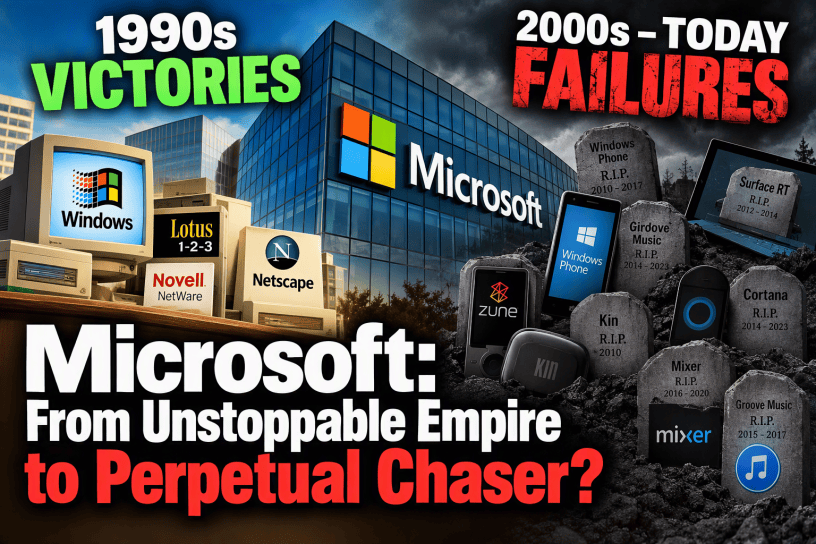
For much of the 1990s, Microsoft looked invincible. It defeated or marginalized one rival after another and established an ecosystem that dominated personal computing. Windows became the standard desktop operating system. Office became the standard productivity suite. Internet Explorer crushed Netscape. Windows NT and later Windows Server eroded Novell’s dominance in networking. Even IBM’s OS/2, once viewed as a serious competitor, faded into irrelevance.
The Microsoft of the 1990s was aggressive, feared, and extraordinarily successful.
Yet if the story of Microsoft in the 1990s is one of relentless victory, the story of Microsoft since roughly the turn of the century is often one of missed opportunities, strategic missteps, and expensive failures. While the company remains enormously profitable thanks largely to Windows, Office, Azure, and enterprise contracts, its record in creating new consumer technology categories has been remarkably poor.
One could argue that Microsoft’s history since 2000 has been defined less by winning new markets and more by losing them.
The Era of Microsoft Dominance
To understand the contrast, it’s worth remembering just how powerful Microsoft once was.
In operating systems, IBM’s OS/2 was supposed to be the future. Microsoft initially worked on it with IBM before ultimately pushing Windows instead. By the mid-1990s, Windows 95 had effectively won the battle for desktop computing.
In networking, Novell’s NetWare was once the standard for enterprise networking. Microsoft gradually displaced it through the growth of Windows NT and later Windows Server products.
In productivity software, Lotus 1-2-3 and Lotus SmartSuite were industry leaders. Microsoft Office eventually became the dominant office suite worldwide.
In web browsers, Netscape Navigator appeared unbeatable in the mid-1990s. Microsoft bundled Internet Explorer with Windows and ultimately reduced Netscape’s market share to near zero.
The company developed a reputation for entering markets late, overwhelming competitors with resources, and emerging victorious.
Unfortunately for Microsoft, this formula stopped working.
The Mobile Disaster
No failure better symbolizes Microsoft’s struggles than mobile computing.
Ironically, Microsoft was not absent from mobile devices. Windows CE and Windows Mobile existed years before the iPhone. In many ways, Microsoft had a head start.
The problem was vision.
While Apple reimagined the smartphone as a touch-first consumer device and Google pursued an open ecosystem with Android, Microsoft remained trapped in desktop-era thinking. Windows Mobile felt like a tiny version of Windows rather than a product designed specifically for phones.
The company eventually scrapped Windows Mobile and launched Windows Phone.
Windows Phone was actually well-designed. Many reviewers praised its interface and distinctive tile system. But the platform arrived too late.
Developers focused on iOS and Android. Consumers wanted app ecosystems. Carriers prioritized platforms with momentum.
Microsoft spent billions trying to catch up. It partnered with Nokia. Then it acquired Nokia’s handset business in a deal widely regarded as one of the worst acquisitions in technology history.
The result was catastrophic.
Windows Phone disappeared. Nokia’s mobile business collapsed. Microsoft wrote off billions of dollars and laid off thousands of employees.
Today the smartphone market is effectively controlled by Apple and Google.
Microsoft, despite having started in mobile long before the iPhone, is almost entirely absent.
Zune: The iPod Killer That Wasn’t
Perhaps no Microsoft product has become more synonymous with failure than Zune.
Apple’s iPod had transformed digital music. Rather than creating something radically different, Microsoft attempted to replicate Apple’s success.
The Zune wasn’t necessarily a bad device. Some users genuinely preferred it to the iPod.
But it arrived late.
Microsoft underestimated the strength of Apple’s ecosystem, brand loyalty, and integration between hardware and software.
Consumers already owned iPods. Developers supported Apple’s platform. Music buyers understood Apple’s ecosystem.
The Zune never gained meaningful market share and was eventually discontinued.
Today, the Zune is remembered less as a competitor and more as a punchline.
The Search Engine Wars
Microsoft’s attempts to challenge Google in web search have consumed enormous resources.
MSN Search became Windows Live Search.
Windows Live Search became Bing.
Billions were invested.
Despite improvements in quality, Bing spent years remaining a distant second to Google.
Even after AI enhancements and integration across Microsoft products, Google’s brand remains practically synonymous with search itself.
Microsoft deserves credit for persistence, but the reality remains that the company failed to meaningfully disrupt Google’s dominance after decades of trying.
The Social Networking Failures
While Facebook, Twitter, LinkedIn, Instagram, Snapchat, and TikTok reshaped online interaction, Microsoft repeatedly failed to establish relevance in social networking.
The company launched or supported numerous social initiatives that either faded away or never gained significant traction.
Perhaps the most striking example is that Microsoft’s biggest social media success was not creating its own network but purchasing LinkedIn.
Instead of winning the social networking battle through innovation, Microsoft effectively bought its way into the market.
Internet Explorer: Victory Turned Into Defeat
Ironically, one of Microsoft’s biggest victories eventually became one of its biggest failures.
Internet Explorer crushed Netscape and dominated web browsing.
Then Microsoft largely stopped innovating.
As competitors emerged, Internet Explorer developed a reputation for poor standards support, security problems, and sluggish development.
Mozilla’s Firefox began gaining momentum.
Then Google launched Chrome.
Internet Explorer’s market share steadily collapsed.
Microsoft eventually abandoned Internet Explorer and replaced it with Edge.
The lesson was painful: winning a market does not guarantee keeping it.
The Tablet Miscalculation
Microsoft recognized the potential of tablet computing long before Apple.
Unfortunately, recognizing a trend is not the same as successfully executing on it.
For years Microsoft promoted tablet PCs that essentially ran desktop Windows with stylus input.
The products were complex, expensive, and failed to attract mainstream consumers.
Then Apple released the iPad.
The iPad accomplished what Microsoft’s tablet initiatives never could. It made tablets simple, accessible, and desirable.
Microsoft was again left reacting instead of leading.
Surface RT and Windows RT
One of Microsoft’s most confusing product experiments was Windows RT.
The idea was to create ARM-based devices that felt like Windows machines.
Unfortunately, many customers didn’t understand that traditional Windows applications wouldn’t run on Windows RT.
Consumers bought what looked like a Windows computer and discovered that many expected programs were incompatible.
The result was confusion, poor sales, and significant financial write-downs.
Windows RT quickly became another entry in Microsoft’s growing list of abandoned initiatives.
Kin: The Product That Barely Lived
Among Microsoft’s many failures, Kin deserves special mention.
Released in 2010, Kin phones targeted younger users focused on social networking.
The devices were poorly positioned and confusing.
Sales were disastrous.
Reports suggested the product lasted only weeks before being canceled.
Kin became a textbook example of a major corporation launching a product without clearly understanding the market.
Cortana vs Siri and Google Assistant
Voice assistants appeared to be an important future technology.
Apple launched Siri.
Google launched Google Assistant.
Amazon launched Alexa.
Microsoft launched Cortana.
Despite being integrated into Windows, Cortana never established the same mindshare or ecosystem presence as its competitors.
Over time Microsoft steadily reduced Cortana’s role and eventually abandoned its broader ambitions for the platform.
Another market entered. Another market lost.
Mixer vs Twitch
The rise of online game streaming created another opportunity.
Microsoft attempted to challenge Twitch through Mixer.
The company even signed major streaming personalities to exclusive contracts.
Despite spending heavily, Mixer failed to gain sufficient audience share.
Eventually Microsoft shut the service down.
Twitch remained dominant.
Groove Music
Music services became a key digital battleground in the streaming era.
Spotify succeeded.
Apple Music succeeded.
Amazon Music gained traction.
Google offered competing solutions.
Microsoft’s answer was Groove Music.
Few consumers cared.
The service ultimately disappeared.
Windows 8: A Solution Looking for a Problem
Not every Microsoft failure was a canceled product.
Some were successful products handled poorly.
Windows 8 attempted to unify desktop and touch computing through a radically redesigned interface.
Users accustomed to traditional desktop workflows reacted negatively.
The removal of familiar interface elements generated widespread frustration.
Microsoft eventually reversed many decisions in Windows 8.1 and Windows 10.
While Windows survived, Windows 8 demonstrated how disconnected Microsoft’s design priorities could become from customer expectations.
The Consumer Hardware Problem
Unlike Apple, Microsoft rarely became a dominant force in consumer hardware.
The company has certainly achieved successes, particularly with Xbox and some Surface products.
But compared to its software victories, Microsoft’s hardware record is uneven.
For every Xbox, there is a Zune.
For every successful Surface model, there is a Surface RT.
For every hardware success, another product seems destined for Microsoft’s graveyard.
The Pattern Behind the Failures
A common theme appears throughout many Microsoft failures.
The company often recognized important trends.
It saw mobile computing.
It saw tablets.
It saw digital music.
It saw social networking.
It saw voice assistants.
It saw streaming.
The problem was usually execution.
Microsoft frequently entered markets too late, misunderstood user priorities, or attempted to extend Windows-centric thinking into environments that required entirely new approaches.
The company often viewed emerging categories through the lens of its existing business rather than the perspective of customers.
By the time Microsoft adapted, competitors had already established ecosystems that were difficult or impossible to displace.
An Era of Defensive Success
It would be unfair to claim Microsoft has failed as a business.
The company remains one of the most valuable corporations in the world.
Azure is a major success. Office remains dominant. Windows continues to have an enormous installed base. Xbox has carved out a significant position in gaming. Enterprise software remains a strength.
But these successes largely reinforce Microsoft’s traditional areas of competence.
The company’s greatest achievements in the last two decades have often involved defending existing advantages or serving enterprise customers rather than creating transformative consumer products.
When new consumer technology markets emerged, Microsoft frequently found itself chasing leaders rather than becoming one.
Conclusion
Microsoft’s story is one of the great paradoxes in technology history.
The company that defeated IBM’s OS/2, Novell NetWare, Lotus, and Netscape seemed capable of conquering any market it entered. During the 1990s, Microsoft’s victories appeared almost inevitable.
But the decades that followed told a different story.
Windows Phone failed. Nokia failed. Zune failed. Kin failed. Mixer failed. Groove Music failed. Cortana failed. Windows RT failed. Tablet PC initiatives failed. Internet Explorer lost its dominance. Multiple social networking efforts never gained traction.
Microsoft remains wealthy, influential, and highly relevant. Yet many of its most celebrated modern achievements involve cloud computing and enterprise services rather than consumer innovation.
The company that once shaped the future of technology increasingly appears to spend its time reacting to futures created by others.
That may be the harshest criticism of Microsoft’s modern era: not that the company lacks resources, talent, or ambition, but that after winning so many defining battles in the 1990s, it has spent much of the twenty-first century watching others define the next generation of computing while it struggles to catch up.

