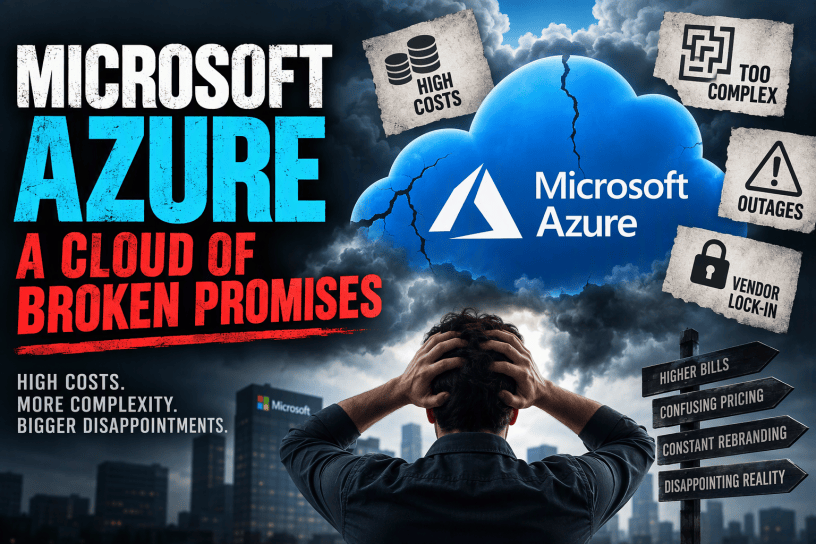
For more than a decade, Microsoft Azure has been marketed as the foundation of the future. Enterprise executives are told it is the platform that will transform their businesses, developers hear it is the ideal environment for innovation, and investors see it as one of Microsoft’s greatest success stories. On paper, Azure appears unstoppable. It is one of the world’s largest cloud platforms and a central pillar of Microsoft’s modern identity.
Yet beneath the impressive revenue numbers, marketing campaigns, and glossy presentations lies a platform that is far from perfect. While Azure has undoubtedly become a major force in cloud computing, it is also a product that has accumulated significant criticism from customers, IT professionals, and developers. Its complexity, pricing model, reliability concerns, and relentless push toward vendor lock-in have frustrated users who expected a simpler and more open cloud experience.
This article takes a critical look at Microsoft Azure and examines why many organizations find the platform far less appealing than Microsoft’s sales teams would suggest.
The Problem of Overwhelming Complexity
One of Azure’s biggest weaknesses is its sheer complexity.
Cloud platforms are naturally complicated, but Azure often feels as though complexity has become a feature rather than a necessary consequence of scale. New users are immediately confronted by an endless collection of services, naming conventions, portals, management interfaces, and configuration options.
Virtual Machines, Virtual Networks, Network Security Groups, Load Balancers, Availability Sets, Scale Sets, Resource Groups, Managed Identities, Key Vaults, Azure Monitor, Azure Policy, Defender for Cloud, and hundreds of other services create a maze that can overwhelm even experienced administrators.
Microsoft frequently adds new services while renaming or reorganizing existing ones. As a result, documentation, training materials, and best practices can quickly become outdated.
Instead of simplifying cloud management, Azure often turns routine administrative tasks into exercises in navigation and configuration. Organizations that move to Azure expecting reduced complexity frequently discover they have simply exchanged one form of complexity for another.
The Confusing User Experience
The Azure Portal is promoted as a centralized interface for managing cloud resources, but many users find it cluttered and inconsistent.
Menus frequently change locations. Similar settings can be scattered across multiple screens. Different services often have entirely different management experiences despite belonging to the same platform.
This inconsistency creates a steep learning curve.
An administrator who masters one area of Azure may find that another service behaves in completely different ways. The platform often feels as though it was assembled from separate products rather than designed as a unified ecosystem.
The result is a user experience that can be frustrating, particularly for smaller organizations without dedicated cloud specialists.
Pricing That Feels Intentionally Obscure
Cloud vendors often claim that customers only pay for what they use. While technically true, Azure’s pricing structure frequently makes it difficult to determine exactly what that usage will cost.
The platform contains thousands of pricing variables:
- Compute charges
- Storage charges
- Data transfer fees
- Backup costs
- Monitoring costs
- Licensing fees
- API calls
- Transaction-based pricing
- Regional price differences
A seemingly simple deployment can generate a surprisingly complicated bill.
Organizations frequently discover hidden costs after services are deployed. Data egress charges, storage transactions, and monitoring expenses can dramatically increase monthly spending.
The Azure Pricing Calculator is intended to help customers estimate costs, but predicting real-world bills remains difficult for many workloads.
For critics, this complexity is not accidental. When pricing becomes difficult to understand, customers may struggle to recognize inefficiencies, making it easier for costs to grow unnoticed.
The Shock of Unexpected Bills
Many Azure users have experienced the infamous cloud cost surprise.
A test environment forgotten over the weekend can result in unexpected expenses. Poorly configured services can scale beyond expectations. Development teams can accidentally consume costly resources without realizing it.
In traditional on-premises environments, hardware expenditures are generally known upfront. Cloud spending, by contrast, can grow continuously.
Numerous organizations have learned that migrating to Azure does not automatically reduce costs. In some cases, cloud expenses exceed the costs of maintaining internal infrastructure.
The promise of lower operational expenses often collides with the reality of ongoing consumption-based billing.
Reliability Concerns and Service Outages
Cloud providers frequently market their services as highly reliable, but Azure has experienced its share of significant outages.
Like every major cloud platform, Azure has faced incidents involving:
- Network failures
- Authentication issues
- Regional outages
- DNS problems
- Storage disruptions
- Management plane failures
When Azure experiences a major incident, the effects can be substantial. Organizations that have centralized critical workloads on Microsoft’s infrastructure may suddenly find themselves unable to access essential systems.
The scale of Azure means that a single outage can affect thousands of businesses simultaneously.
This creates an uncomfortable contradiction. Companies move to the cloud to improve resilience, yet concentration within a handful of giant cloud providers can create new forms of systemic risk.
Vendor Lock-In by Design
Microsoft often speaks about openness and interoperability, but critics argue that Azure remains deeply tied to Microsoft’s broader ecosystem.
Organizations using Azure are strongly encouraged to adopt:
- Microsoft 365
- Entra ID (formerly Azure Active Directory)
- SQL Server
- Windows Server
- Power Platform
- Dynamics 365
- Microsoft Security products
Each service integrates tightly with the others, creating a powerful incentive to remain within the Microsoft ecosystem.
While these integrations can provide convenience, they also make migration increasingly difficult.
Once an organization’s identity, collaboration tools, databases, data analytics platforms, and security infrastructure become intertwined with Azure, moving elsewhere can become an expensive and risky undertaking.
Many customers discover that entering the Microsoft ecosystem is far easier than leaving it.
Constant Rebranding and Renaming
Microsoft has a long history of renaming products, and Azure is no exception.
Examples include:
- Azure Active Directory becoming Entra ID
- Microsoft Defender products being repeatedly reorganized
- Security services receiving new branding
- Management solutions changing names over time
While rebranding may make sense from a marketing perspective, it often creates confusion for administrators, trainers, consultants, and customers.
Tutorials become outdated. Certifications require revision. Documentation must be updated.
Instead of focusing on technical improvements, organizations often spend time simply trying to keep up with Microsoft’s shifting terminology.
The Documentation Problem
Microsoft has invested heavily in documentation, yet Azure documentation remains a source of frustration.
The problem is not necessarily a lack of documentation but rather too much of it.
Users can encounter:
- Multiple documents covering similar topics
- Contradictory guidance
- Outdated screenshots
- Preview features mixed with production recommendations
- Rapidly changing references
Finding the correct information frequently becomes an exercise in detective work.
Developers and administrators often spend significant time sorting through search results to determine which documentation applies to their specific scenario.
For a platform marketed toward efficiency, this can feel remarkably inefficient.
Enterprise Focus at the Expense of Everyone Else
Azure often appears designed primarily for large enterprises rather than small businesses or independent developers.
Large corporations may have:
- Dedicated cloud architects
- Security teams
- FinOps specialists
- Compliance experts
- DevOps engineers
Smaller organizations often do not.
As a result, Azure’s complexity can impose a disproportionate burden on startups and small businesses.
Many independent developers find simpler cloud providers easier to understand and manage. Platforms with more straightforward interfaces and pricing models may provide adequate functionality without requiring an extensive investment in specialized expertise.
Azure’s enterprise-first philosophy can leave smaller users feeling like second-class citizens.
Security Challenges in a Complex Environment
Microsoft frequently promotes Azure’s security capabilities, and Azure certainly includes an impressive collection of security tools.
However, sophisticated security features do not automatically produce secure deployments.
Complexity itself becomes a security risk.
Misconfigured storage accounts, overly permissive permissions, exposed services, and improperly secured virtual machines have all appeared in real-world cloud environments.
The challenge is that Azure provides many security controls but also creates countless opportunities for human error.
A platform may offer excellent security mechanisms on paper while remaining difficult to secure in practice.
The Certification Industry Around Azure
Microsoft has built a massive certification ecosystem around Azure.
Certifications can undoubtedly benefit professionals seeking to validate skills. However, critics argue that Azure’s complexity has helped create an industry in which constant retraining becomes necessary.
As services evolve and branding changes, professionals must continually update certifications and training materials.
Organizations spend considerable amounts of money preparing staff for exams tied to technologies that may change significantly within a few years.
While education is valuable, the pace of Azure’s evolution can sometimes feel exhausting rather than empowering.
The Growing Dependence on the Cloud
Azure reflects a larger trend within the technology industry: the push toward cloud dependency.
Microsoft increasingly encourages customers to adopt cloud-first strategies, moving workloads away from locally controlled infrastructure.
For Microsoft, the financial incentives are obvious. Subscription revenue creates predictable recurring income. Cloud services generate ongoing consumption-based charges.
For customers, however, the equation is not always so clear.
Organizations may lose:
- Direct infrastructure control
- Flexibility
- Cost predictability
- Independence from external providers
When core operations become dependent on Azure, businesses also become dependent on Microsoft’s priorities, pricing decisions, and roadmap choices.
This imbalance can leave customers with limited leverage.
AI and the Next Wave of Complexity
Azure’s future is increasingly tied to artificial intelligence.
Microsoft positions Azure as a platform for deploying and managing AI workloads, integrating large language models, machine learning services, and advanced analytics capabilities.
While these offerings attract considerable attention, they also introduce new layers of complexity.
Organizations must now consider:
- GPU costs
- Model hosting
- AI governance
- Compliance requirements
- Data privacy concerns
- Prompt security
- Model performance optimization
Instead of simplifying computing, the AI era may further increase Azure’s already daunting complexity.
Customers who struggled to understand traditional cloud infrastructure may find AI-related cloud services even more difficult to manage effectively.
Microsoft’s Financial Priorities
Critics often argue that Azure’s design reflects Microsoft’s financial objectives as much as customer needs.
The platform encourages continual expansion:
- More services
- More integrations
- More storage
- More compute consumption
- More subscriptions
Every additional workload generates revenue.
While this incentive structure is not unique to Microsoft, it raises legitimate questions about whether platform decisions are always aligned with customer interests.
A company focused on maximizing cloud revenue may not always prioritize simplicity, portability, or cost reduction.
Conclusion: Success Does Not Eliminate Legitimate Criticism
There is no denying Azure’s significance. It powers major organizations around the world, supports a vast ecosystem of applications, and generates enormous revenue for Microsoft. By many business metrics, Azure is unquestionably successful.
Yet success should not shield a platform from criticism.
Azure often suffers from excessive complexity, confusing pricing, inconsistent user experiences, difficult documentation, and a business model that encourages long-term dependence on Microsoft’s ecosystem. Organizations that adopt Azure expecting effortless scalability and lower costs frequently encounter a more complicated reality.
The cloud promises simplicity, flexibility, and efficiency. Azure sometimes delivers those benefits, but it often delivers new challenges as well.
For all of Microsoft’s marketing about digital transformation, cloud innovation, and AI-powered futures, Azure remains a platform that many customers tolerate rather than truly love. Its dominance in the market may reflect Microsoft’s reach and enterprise relationships as much as any inherent superiority.
As Azure continues to expand, Microsoft faces an important challenge: proving that growth alone is not enough. A cloud platform should empower its customers, not overwhelm them. Until Azure addresses many of the concerns raised by critics, questions will remain about whether Microsoft’s cloud vision genuinely serves users or primarily serves Microsoft itself.

