For years, Microsoft has attempted to convince users that Edge is the browser they should be using. Introduced as the successor to Internet Explorer and later rebuilt on Google’s Chromium engine, Microsoft Edge was supposed to symbolize a fresh start for the company. It was marketed as faster, more secure, more efficient, and better integrated with modern computing needs.
Yet despite Microsoft’s enormous resources and relentless promotion, Edge continues to struggle with a fundamental problem: many people use it not because they love it, but because Microsoft puts it in front of them.
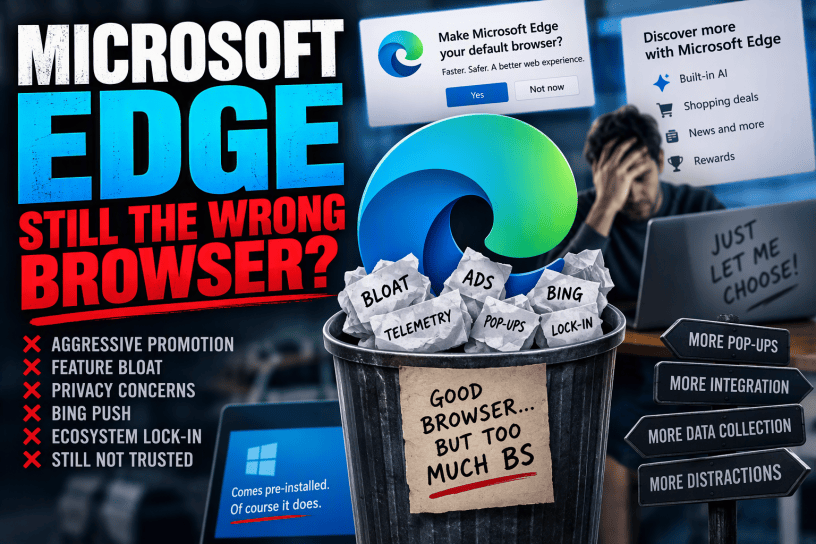
Although Edge has certainly improved over the years and is technically a competent browser, it remains a product weighed down by aggressive marketing tactics, feature bloat, privacy concerns, ecosystem lock-in, and a constant sense that Microsoft is trying too hard to make users choose it. Rather than winning users through superior design alone, Edge often feels like a browser that relies heavily on Microsoft’s control over Windows to maintain relevance.
This article takes a critical look at Microsoft Edge and examines why it continues to draw criticism despite years of development and investment.
The Browser Nobody Actually Asked For
One of Edge’s biggest challenges is that it was born from failure.
Internet Explorer, once dominant in the browser market, became synonymous with poor performance, security problems, and outdated web standards. When Microsoft introduced the original Edge browser alongside Windows 10, it was presented as a complete break from the mistakes of Internet Explorer.
The problem was that users had already moved on.
Many consumers and businesses had adopted Google Chrome or Mozilla Firefox long before Edge arrived. Developers optimized websites for these browsers. Users had established habits and extensions. Enterprises had standardized workflows built around alternative platforms.
Instead of entering a market hungry for innovation, Edge entered one that was already largely settled.
Microsoft was effectively trying to persuade users to abandon products they were already comfortable with in favor of another Microsoft browser. Unsurprisingly, many were unconvinced.
From Independence to Chromium
Perhaps the most telling criticism of Edge is Microsoft’s decision to abandon its original browser engine.
The original EdgeHTML engine was supposed to compete directly with Chromium and Firefox. Instead, Microsoft eventually gave up and adopted Google’s Chromium project as the foundation of Edge.
From a practical standpoint, this decision improved compatibility. Many websites immediately behaved better under the Chromium-based version of Edge.
However, the move also raised uncomfortable questions.
If Microsoft’s own browser technology could not compete successfully, what did that say about Microsoft’s browser strategy?
Critics argue that Edge’s transition to Chromium transformed it from a genuine competitor into what is essentially another Chromium browser with Microsoft’s branding attached.
While Microsoft contributes to Chromium development, the browser’s reliance on Google’s technology highlights how difficult it has become to challenge Google’s influence over the web.
Constant Promotion Within Windows
Perhaps the most common criticism directed at Edge is Microsoft’s relentless effort to promote it inside Windows.
Users frequently encounter:
- Prompts encouraging Edge usage
- Recommendations to make Edge the default browser
- Warnings when downloading competing browsers
- Notifications highlighting Edge features
- Search result promotions
- Settings screens designed to discourage browser switching
Many users describe these tactics as annoying, intrusive, or manipulative.
Rather than allowing Edge to compete purely on merit, Microsoft often appears determined to leverage its dominance in operating systems to gain browser market share.
The frequent appearance of promotional messages can make users feel less like customers and more like marketing targets.
The Default Browser Wars Never End
Changing default applications should be simple.
Yet Microsoft has repeatedly been criticized for making it more difficult than necessary to switch away from Edge.
Various versions of Windows have introduced processes requiring users to change defaults file type by file type, protocol by protocol, instead of using a straightforward browser replacement option.
Although some improvements have been made over time, critics argue that Microsoft’s behavior reflects a company unwilling to accept that many Windows users prefer alternative browsers.
The constant battle over default status creates unnecessary friction and contributes to perceptions that Microsoft prioritizes product promotion over user choice.
Feature Bloat Everywhere
Modern browsers have become increasingly complex, but Edge has embraced feature creep with remarkable enthusiasm.
In addition to core web browsing functionality, Edge now includes features related to:
- Shopping
- Coupons
- Gaming
- News feeds
- Cryptocurrency wallets
- AI assistants
- Rewards programs
- Sidebar applications
- Productivity tools
- Image creation
- Content recommendations
At some point, the browser began feeling less like a web browser and more like a collection of unrelated services bundled together.
Many users simply want a browser that loads websites quickly and reliably.
Instead, they encounter a growing list of features they never requested and may never use.
This accumulation of functionality contributes to an interface that can feel increasingly cluttered and distracting.
The News Feed Problem
One frequently criticized component of Edge is the default new tab experience.
Rather than presenting a clean page, Edge often displays a feed packed with:
- Headlines
- Celebrity stories
- Clickbait articles
- Sponsored content
- Trending topics
- Promotional material
Some users find the experience overwhelming.
What could have been a simple gateway to web browsing instead resembles a content portal designed to maximize engagement and advertising opportunities.
The quality of recommended content is often questioned, with critics arguing that sensational material receives disproportionate visibility.
For users seeking a minimalist browsing experience, the default Edge homepage can feel unnecessarily chaotic.
Privacy Concerns and Data Collection
Microsoft promotes Edge as a secure browser, but privacy advocates have raised concerns regarding data collection practices.
Modern browsers collect substantial amounts of telemetry and usage information. Edge is no exception.
Depending on settings and integrations, Microsoft may receive information related to:
- Browser usage
- Search activity
- Diagnostic data
- Performance metrics
- Feature interaction
While much of this data collection is disclosed and configurable, critics argue that privacy controls are often buried within complex settings menus.
Users increasingly expect transparency and simplicity when managing their personal information.
When privacy options become difficult to navigate, trust can suffer.
The Microsoft Ecosystem Trap
Edge is deeply integrated into Microsoft’s broader ecosystem.
Microsoft clearly hopes users will connect Edge to:
- Microsoft accounts
- Microsoft 365
- OneDrive
- Bing
- Copilot
- Outlook
- Windows services
- Microsoft Rewards
Each integration offers convenience, but collectively they strengthen Microsoft’s ecosystem lock-in.
The more services a user adopts, the harder it becomes to leave.
This strategy makes good business sense, but critics argue it puts Microsoft’s interests ahead of user flexibility.
A browser should act as a gateway to the web, not as a mechanism for reinforcing dependence on a single vendor.
Bing Integration That Refuses to Go Away
Microsoft’s commitment to Bing is understandable. Search is a massive business.
However, many users feel Edge pushes Bing far more aggressively than necessary.
Examples include:
- Bing-centric defaults
- Persistent search recommendations
- Integration throughout browser features
- Promotional messaging tied to search usage
Users who prefer alternative search engines often find themselves repeatedly adjusting settings or encountering reminders about Microsoft’s preferred services.
Rather than feeling like a neutral platform, Edge can feel like a marketing vehicle for Bing.
Performance Claims Versus Reality
Microsoft frequently highlights Edge’s speed and efficiency.
In fairness, Edge often performs well in benchmark tests and can be competitive with other Chromium-based browsers.
The problem is that performance differences between modern browsers are often relatively small in real-world usage.
For many users, Chrome, Firefox, Brave, Edge, and other browsers feel similarly responsive during everyday browsing.
As a result, Microsoft’s dramatic performance claims can sometimes appear exaggerated relative to the actual experience.
Users may be promised transformative gains only to discover differences that are barely noticeable during normal use.
Too Many Settings, Too Many Menus
Edge has accumulated an enormous number of settings.
While customization is generally positive, Edge sometimes crosses the line into confusion.
Features can be spread across multiple sections and submenus.
Finding specific controls may require navigating through:
- Privacy settings
- Profile settings
- Appearance settings
- Sidebar settings
- Experimental options
- Shopping features
- AI configurations
The abundance of options reflects years of continuous additions without equivalent simplification.
Instead of feeling streamlined, the browser can feel increasingly crowded with controls.
Enterprise Management Complexity
Organizations often appreciate Microsoft’s enterprise management capabilities.
However, these capabilities can also create complexity.
Administrators may need to manage:
- Security policies
- Group Policy configurations
- Extension governance
- Identity integrations
- Compliance requirements
- Data protection rules
Large organizations may have the resources to handle these requirements.
Smaller businesses often do not.
As a result, Edge sometimes appears optimized for enterprise administrators rather than ordinary users.
The AI Rush
In recent years, Microsoft has heavily promoted AI features within Edge.
Copilot integrations, AI-assisted tools, content generation features, and browser-based AI experiences have become central parts of Microsoft’s strategy.
While some users enjoy these capabilities, others view them as yet another example of feature overload.
Not every browser activity requires AI assistance.
Many users simply want to browse websites, read articles, watch videos, and perform searches.
The industry’s rush to integrate AI into every possible product risks making browsers more complex without necessarily making them better.
Edge has become one of the clearest examples of this trend.
Reputation Issues That Never Fully Disappeared
Even though Edge is no longer Internet Explorer, Microsoft’s browser reputation still casts a long shadow.
For decades, Microsoft browsers were associated with:
- Security vulnerabilities
- Compatibility issues
- Slow innovation
- Corporate dominance
- Web standard disputes
Edge inherited some of that baggage.
Many users who abandoned Internet Explorer years ago never felt a strong reason to return to a Microsoft browser, regardless of technical improvements.
Reputations can take decades to build and only slightly less time to destroy.
Microsoft continues to suffer from decisions made long before the modern version of Edge existed.
Success Through Distribution
One criticism repeatedly aimed at Edge is that its growth owes more to distribution than demand.
Unlike smaller browser vendors, Microsoft controls the world’s most popular desktop operating system.
Edge ships with Windows, receives prominent placement, and benefits from extensive operating system integration.
Critics argue that if Microsoft lacked control of Windows, Edge would struggle far more to maintain its current position.
This does not mean Edge is a bad browser. It means that its market presence may reflect Microsoft’s broader ecosystem power as much as consumer preference.
Conclusion: A Good Browser That Tries Too Hard
Microsoft Edge is not a disaster. In fact, it is technically capable, reasonably fast, fairly secure, and compatible with modern web standards.
Ironically, that makes its shortcomings more frustrating.
The biggest problem with Edge is not poor engineering. The biggest problem is Microsoft’s apparent inability to let the browser stand on its own merits.
Aggressive promotion, ecosystem lock-in, feature bloat, Bing integration, AI overload, cluttered interfaces, and constant encouragement to stay within Microsoft’s products all contribute to an experience that many users find exhausting.
A truly confident browser would focus on delivering an outstanding browsing experience and allow users to choose it voluntarily. Too often, Edge feels like a browser accompanied by a marketing campaign that never ends.
Microsoft has spent years improving Edge’s technology, but technology alone is not enough. Trust, simplicity, user choice, and restraint matter as well. Until Microsoft learns to prioritize those values over relentless engagement and ecosystem expansion, Edge will likely remain a browser that people use because it is there, not because they genuinely prefer it.
That may be enough to maintain market share, but it is a very different thing from earning user loyalty.

