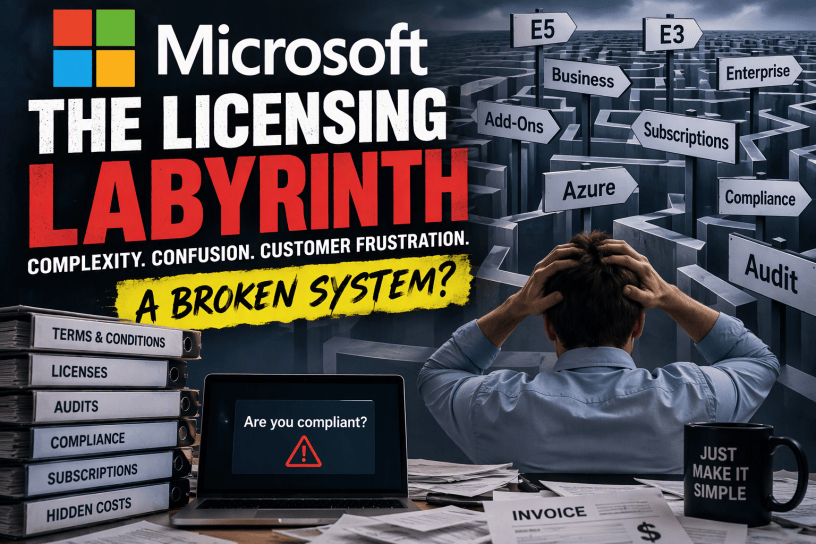
For decades, Microsoft has been one of the most successful technology companies in history. Its software powers businesses, governments, schools, and homes across the globe. Yet alongside its technical achievements, Microsoft has cultivated a reputation for something far less admirable: licensing complexity. While competitors increasingly emphasize simplicity, transparency, and predictable pricing, Microsoft licensing often feels like a sprawling maze designed by accountants for other accountants.
To be fair, software licensing is inherently complicated. Large enterprises have diverse needs, regulatory requirements vary by region, and cloud services introduce new variables. However, many critics argue that Microsoft has gone far beyond necessary complexity. What should be a straightforward process of purchasing and using software has become an ecosystem of product editions, subscription tiers, user licenses, device licenses, cloud entitlements, add-ons, exceptions, and ever-changing terms.
The result is a licensing environment that frustrates customers, enriches consultants, and creates significant uncertainty for organizations trying to budget and plan effectively.
The Never-Ending List of Editions
One of the most visible problems with Microsoft’s licensing strategy is the sheer number of product editions.
Consider Windows. Depending on the usage scenario, customers may encounter Home, Pro, Pro for Workstations, Enterprise, Enterprise LTSC, Education, and other specialized variants. Each edition includes slightly different capabilities, management features, and licensing rules.
Then look at Microsoft 365.
An organization trying to select a productivity suite may need to compare:
- Microsoft 365 Business Basic
- Microsoft 365 Business Standard
- Microsoft 365 Business Premium
- Microsoft 365 Apps for Business
- Microsoft 365 E3
- Microsoft 365 E5
- Office 365 E1
- Office 365 E3
- Office 365 E5
- Numerous add-on subscriptions
Even experienced IT professionals often need comparison charts just to understand which features belong to which plan.
When software purchasing requires extensive documentation merely to determine what is included, something has gone wrong.
Many customers do not want dozens of subtly different editions. They want a product that performs their required tasks at a reasonable price. Instead, Microsoft frequently seems to optimize for market segmentation over clarity.
The Enterprise Agreement Trap
Large organizations often enter Microsoft’s Enterprise Agreement ecosystem expecting predictable licensing and volume discounts.
What they frequently discover instead is a long-term commitment filled with intricate compliance requirements and periodic changes.
Enterprise Agreements can create situations where organizations become deeply dependent on Microsoft products while simultaneously struggling to understand their actual obligations. Licensing audits become a concern. Internal tracking systems must be maintained. Dedicated staff may be required simply to ensure compliance.
The irony is striking.
The software itself is supposed to improve organizational efficiency. Yet many enterprises dedicate significant resources solely to managing the right to use that software.
A licensing system should reduce administrative burden. Microsoft’s approach often increases it.
Software Audits: The Fear Factor
Few topics generate more anxiety in corporate IT departments than software audits.
Microsoft is hardly the only vendor that conducts audits, but the complexity of its licensing structure can make audit preparation particularly stressful.
Organizations may have purchased products correctly and still struggle to demonstrate compliance because of confusing documentation requirements or shifting rules around virtualization, remote access, or cloud usage.
This creates an uncomfortable relationship between vendor and customer.
Instead of feeling like a partner helping businesses succeed, Microsoft can sometimes appear to be an enforcer waiting to identify technical violations buried within hundreds of pages of licensing documentation.
Even when audits do not result in penalties, they often consume substantial amounts of time and money.
The existence of an entire industry dedicated to Microsoft licensing consultants speaks volumes about the system itself.
If customers need specialists to explain how to legally use products they have already purchased, the licensing model has likely become too complicated.
Cloud Licensing Made Things Worse, Not Better
One of the promises of cloud computing was simplicity.
Customers would no longer need to worry about infrastructure, capacity planning, or complex deployment models. They would simply subscribe and consume services.
Instead, Microsoft’s cloud era arguably introduced a whole new layer of licensing confusion.
Azure pricing alone can be intimidating.
Organizations encounter:
- Consumption-based pricing
- Reserved instances
- Hybrid benefits
- Savings plans
- Pay-as-you-go models
- Capacity reservations
- Various support tiers
Each may offer legitimate value under certain circumstances. The problem is that determining which option actually saves money often requires extensive analysis.
Microsoft frequently advertises cost savings opportunities, but customers must first understand an increasingly complicated landscape to realize those savings.
Rather than simplifying software ownership, cloud services have shifted complexity into billing structures and subscription management.
The Rise of Subscription Fatigue
Another major criticism centers on Microsoft’s aggressive move toward subscriptions.
Historically, customers could purchase software and continue using it indefinitely. New versions appeared periodically, and upgrades were optional.
Today’s environment looks very different.
Many Microsoft products are increasingly positioned around recurring subscriptions. Microsoft 365 has become the centerpiece of Microsoft’s productivity strategy.
From Microsoft’s perspective, subscriptions provide predictable revenue, continuous updates, and cloud integration.
From the customer’s perspective, subscriptions can feel like an endless rent payment.
Organizations that previously made a one-time software investment now face recurring expenses that continue indefinitely. What initially appears affordable on a per-user monthly basis can become substantial when multiplied across hundreds or thousands of employees year after year.
The subscription model itself is not inherently problematic.
The concern is when customers have little practical alternative.
As more functionality becomes tied to subscription services, perpetual licensing options often receive less attention, fewer features, or slower development.
Customers may technically have a choice, but many feel the market reality makes that choice increasingly limited.
E5: The Poster Child for Licensing Confusion
Few products exemplify Microsoft’s licensing philosophy better than Microsoft 365 E5.
E5 bundles a wide range of capabilities, including advanced security, compliance, analytics, communication, and productivity features.
In theory, the bundle simplifies purchasing.
In practice, many organizations find themselves paying for numerous features they never use.
The challenge is determining whether buying the bundle costs less than purchasing individual components.
That analysis can become incredibly complicated because feature availability changes, new capabilities are introduced, and licensing terms evolve over time.
Organizations often discover they either:
- Overpay for unused features.
- Spend enormous effort trying to optimize licensing combinations.
Neither outcome represents true simplicity.
License Mobility and Virtualization Headaches
Microsoft’s licensing rules surrounding virtualization have long been a source of criticism.
Modern data centers rely heavily on virtualization, dynamic workloads, and flexible resource allocation. Yet Microsoft’s licensing framework has frequently struggled to align with these realities.
Organizations running virtual machines may face different requirements depending on:
- Physical cores
- Virtual cores
- Host configurations
- Software Assurance status
- Cloud provider selection
- Hybrid deployment scenarios
What should be a technical infrastructure decision can become a licensing exercise.
Engineers may identify the best architecture for performance and reliability only to discover that licensing implications dramatically alter the cost equation.
In these situations, licensing ceases to support innovation and instead begins shaping technical decisions in potentially undesirable ways.
Constant Rule Changes
One of the most frustrating aspects of Microsoft licensing is that customers cannot simply learn the rules once.
The rules continually change.
Product names evolve.
Licensing programs are retired.
New bundles appear.
Features move between tiers.
Terms and conditions are updated.
Pricing structures are revised.
Businesses that invested time understanding one generation of Microsoft licensing frequently find themselves needing to relearn significant portions of the framework just a few years later.
This creates ongoing operational costs that rarely appear in Microsoft’s marketing materials.
The hidden cost of Microsoft licensing is often not the software itself.
It is the time spent trying to keep up.
The Small Business Problem
Large enterprises can hire licensing experts.
Small businesses usually cannot.
Yet smaller organizations often face many of the same choices.
A small company attempting to purchase Microsoft services may encounter product matrices, technical terminology, overlapping subscriptions, and complicated feature comparisons that seem designed for multinational corporations.
This creates an imbalance.
Organizations with substantial IT budgets can navigate the complexity.
Smaller organizations risk selecting services that are either insufficient for their needs or unnecessarily expensive.
Technology should be accessible.
Licensing complexity creates barriers that disproportionately affect smaller customers.
Vendor Lock-In by Design
Critics often argue that Microsoft’s licensing approach contributes to customer lock-in.
The issue is not merely technical compatibility.
It is operational dependency.
Once an organization has standardized on Microsoft 365, Azure, Windows, Active Directory, Intune, Defender, and various add-on services, changing vendors becomes incredibly difficult.
Licensing structures can reinforce this dependency.
Bundled discounts encourage broader adoption of Microsoft’s ecosystem. Individual products may appear expensive, while comprehensive bundles seem attractive. Over time, organizations become increasingly invested in Microsoft’s platform.
Again, this is not unique to Microsoft.
Many large technology companies pursue ecosystem strategies.
However, Microsoft’s vast product portfolio gives it an unusually powerful ability to bundle services together in ways that make alternatives harder to evaluate and justify.
Complexity Benefits Microsoft
Perhaps the harshest criticism of Microsoft’s licensing strategy is the idea that complexity is not an accident.
Critics argue that complexity serves important business objectives.
Complex systems:
- Make direct comparisons more difficult.
- Increase switching costs.
- Encourage reliance on Microsoft’s sales teams and consultants.
- Reduce pricing transparency.
- Create opportunities for upselling.
Whether intentional or not, Microsoft undeniably benefits from a market environment where licensing expertise carries significant value.
Simple systems tend to empower customers.
Complex systems often empower vendors.
That perception alone has contributed significantly to Microsoft’s licensing reputation.
What Microsoft Should Do Instead
The solution is not difficult to imagine.
Microsoft could dramatically improve customer experience by adopting several principles:
Simplify Product Lines
Reduce overlapping editions and eliminate unnecessary tiers.
Improve Pricing Transparency
Allow customers to understand costs without consulting licensing specialists.
Stabilize Licensing Terms
Minimize frequent rule changes that force organizations to continually reevaluate compliance.
Reduce Bundle Complexity
Create clearer feature packages with less overlap.
Focus on Customer Understanding
If an average IT manager cannot quickly understand licensing implications, the system is too complicated.
Conclusion
Microsoft’s software powers much of the modern digital world. The company’s engineering accomplishments are undeniable, and many of its products deliver genuine value. Yet its licensing practices remain a persistent source of frustration across the industry.
Over the years, Microsoft licensing has evolved into a system characterized by complexity, ambiguity, and constant change. What should be a straightforward transaction often becomes a significant administrative challenge requiring specialized knowledge and ongoing management.
Defenders argue that complexity is unavoidable given Microsoft’s enormous product portfolio and diverse customer base. There is certainly some truth in that argument. Managing licensing for global enterprises, cloud services, educational institutions, governments, and small businesses is not a simple task.
However, complexity has reached a point where it often appears disproportionate to the problem being solved.
When organizations must hire consultants to understand product entitlement, when feature comparisons span dozens of pages, and when customers routinely express confusion about licensing rules, the system is no longer serving its users effectively.
Microsoft has repeatedly shown the ability to reinvent products, platforms, and business models. The company transformed Windows, embraced cloud computing, and became a leader in enterprise services. If it chose to do so, it could also transform software licensing.
Until then, Microsoft’s licensing strategy will remain one of the company’s most criticized and least customer-friendly practices, a reminder that even great technology can be undermined by the way it is sold.

