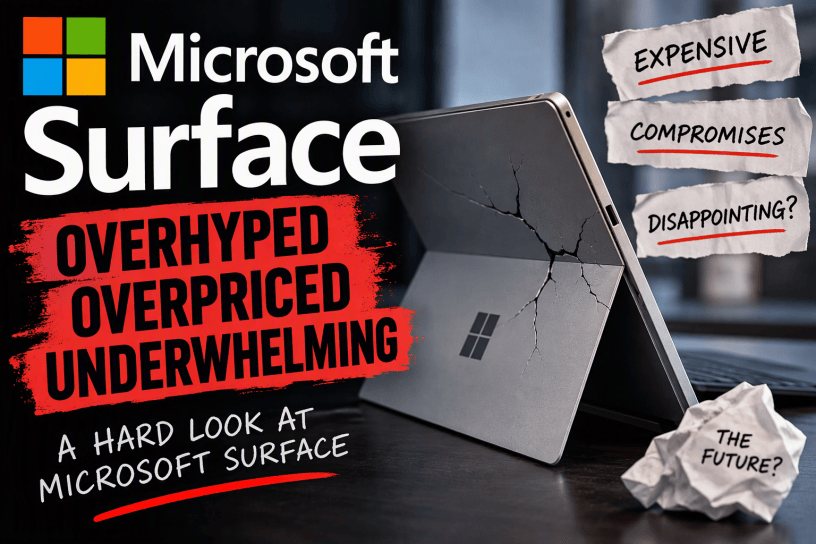
For more than a decade, Microsoft Surface has been presented as the future of personal computing. It has been marketed as the device family that would redefine laptops, tablets, and hybrid computing while showcasing the very best of Windows. Yet despite years of marketing, redesigns, and increasingly premium price tags, Surface remains one of Microsoft’s most frustrating product families.
At its core, the problem is not that Surface devices are terrible. In many cases, they are attractive, well-built, and innovative. The problem is that Microsoft consistently sells Surface as the gold standard for Windows hardware while often delivering an experience that feels unfinished, compromised, or strangely disconnected from the realities of everyday computing.
The Identity Crisis That Never Ends
The Surface brand has spent years trying to answer a question that nobody asked: what if a device could be both a laptop and a tablet?
The issue is that consumers have already answered this question. Most people want either a laptop or a tablet. They rarely want a machine that sits awkwardly between the two.
The original Surface devices were praised for innovation, but innovation alone does not guarantee practicality. The kickstand, detachable keyboards, and tablet-first design created a product that looked futuristic in advertisements but sometimes felt less comfortable than a conventional laptop in real-world use.
Using a Surface on a desk can be perfectly fine. Using one on your lap often reveals the compromises. The kickstand takes up extra space. The keyboard flexes differently than traditional laptops. The balance can feel unusual. These may sound like small issues individually, but when repeated every day for years, they become major annoyances.
Competitors largely moved toward refining the laptop experience. Microsoft continued trying to convince users that hybrid computing was the future.
The market’s response has been mixed at best.
Premium Prices, Questionable Value
One of the biggest criticisms of the Surface lineup is simple: these devices are expensive.
Microsoft positions Surface as a premium product family, often placing it in direct competition with high-end laptops from Dell, Lenovo, HP, and Apple. The problem is that many Surface devices do not clearly justify their price premium.
Consumers frequently find themselves paying more for a Surface while receiving specifications that look merely average on paper. Storage upgrades can be surprisingly expensive. Memory configurations often feel restricted compared to competing systems. Accessory costs add up quickly.
Consider the overall investment required for some Surface models. The device itself can carry a premium price tag. The keyboard may cost extra. The stylus may cost extra. Specialized accessories may cost extra.
What initially appears to be a high-end machine can quickly become a very expensive ecosystem.
Meanwhile, competitors frequently offer more powerful processors, better upgradeability, additional ports, or superior performance for similar or lower prices.
When a company asks customers to pay premium prices, customers reasonably expect premium value. Surface does not always provide that equation.
Windows Showcase Hardware That Doesn’t Always Showcase Windows
Perhaps the most surprising aspect of Surface is that Microsoft, the creator of Windows, often struggles to deliver the definitive Windows experience.
In theory, Surface should represent the perfect marriage of hardware and software. Microsoft controls Windows. Microsoft designs Surface. The combination should be seamless.
Yet Surface devices have occasionally been associated with bugs, firmware problems, driver issues, battery concerns, sleep-state inconsistencies, and software quirks that seem especially embarrassing given Microsoft’s unique position.
When a third-party manufacturer encounters a Windows issue, there is at least some excuse. They do not control the operating system.
Microsoft does not have that excuse.
If anyone should be capable of delivering a flawless Windows experience, it should be Microsoft itself.
The fact that Surface users have sometimes found themselves troubleshooting issues that seem deeply connected to both hardware and software makes the situation even more frustrating.
The Upgradeability Problem
Modern technology increasingly suffers from the trend toward sealed and restricted devices, and Surface has often been among the leading examples.
Repairability and upgradeability have historically been weaknesses of the product family.
For years, many Surface devices gained reputations as difficult machines to service. Components were tightly integrated. Repairs could be complex. Upgrades were frequently impossible or impractical.
Consumers paying premium prices may reasonably expect their devices to last many years. Yet long-term ownership becomes less appealing when RAM cannot be upgraded, storage options are limited, and repairs are challenging.
Microsoft has taken some steps in recent years to improve repairability in certain models, and credit should be given where it is due. However, the broader reputation remains difficult to overcome.
The industry should be moving toward greater sustainability, longer device lifespans, and reduced electronic waste.
Too often, premium modern hardware seems designed around replacement rather than longevity.
Surface has not escaped that criticism.
The Surface Pen: Great Idea, Limited Audience
Microsoft has invested enormous effort into pen computing.
The Surface Pen is technically impressive. Artists, note-takers, and certain creative professionals can do remarkable things with it.
The problem is that the audience may be far smaller than Microsoft’s marketing suggests.
Many customers ultimately purchase the pen because the advertising makes it look essential. Months later, the pen often sits unused in a drawer.
This is not because the technology is bad. It is because most people simply do not spend their day drawing diagrams, sketching illustrations, or annotating documents by hand.
Microsoft has sometimes seemed determined to build products around use cases that sound exciting during demonstrations but prove relatively niche in everyday life.
The result is a product experience focused on features that many customers rarely use while other practical concerns receive less attention.
Performance That Doesn’t Always Match Expectations
Surface devices often prioritize aesthetics, portability, and design elegance.
Unfortunately, those priorities sometimes come at the cost of raw performance.
While competitors aggressively pursue thermal improvements, higher power budgets, and stronger sustained performance, Surface products have occasionally favored thinness and visual appeal.
This can create a disconnect between expectation and reality.
A premium device carrying a premium price naturally raises expectations. Buyers expect speed. They expect responsiveness. They expect the ability to handle demanding workloads.
Yet some Surface models have struggled to distinguish themselves from less expensive alternatives when actual performance benchmarks entered the discussion.
Consumers may forgive limited performance in budget devices. They are much less forgiving when paying flagship prices.
The Port Problem
For years, Surface devices seemed oddly reluctant to embrace industry-standard connectivity options.
While competitors expanded USB-C adoption, Microsoft often moved cautiously. While users requested more flexibility, some Surface models maintained minimal port selections.
This created a curious contradiction.
Microsoft promoted productivity, creativity, and professional workflows while sometimes requiring users to carry adapters, docks, and accessory hubs just to connect everyday devices.
Few things undermine a premium experience faster than discovering that a premium laptop needs an assortment of additional accessories simply to match the connectivity that competitors provide by default.
Although Microsoft has improved in this area over time, the company often appeared reactive rather than proactive.
A Brand Built on Aspirations
Surface frequently feels like a product family designed around aspirations rather than realities.
Microsoft advertisements often showcase architects sketching buildings, executives presenting ideas, designers creating masterpieces, and students transforming the world through digital ink.
The actual experience for many consumers is far less dramatic.
Most people use web browsers.
Most people answer emails.
Most people attend video calls.
Most people create documents.
Most people watch videos.
The advanced capabilities highlighted in marketing campaigns frequently play only a minor role in daily usage.
There is nothing wrong with aspirational advertising, but Surface has at times seemed more interested in selling a vision than solving ordinary computing needs better than the competition.
Constant Reinvention Without Clear Direction
Another recurring issue is Microsoft’s tendency to continually reshape the Surface lineup.
Different generations arrive with different priorities. Product names evolve. Form factors appear and disappear. Experimental ideas emerge and fade away.
The result can be confusion.
Consumers benefit from consistency. Businesses benefit from predictability. Developers benefit from stable ecosystems.
Instead, Surface has sometimes appeared to chase whatever trend seemed most exciting at the moment.
Dual-screen concepts arrive. Unique form factors emerge. New experiments launch. Some quietly disappear.
Innovation is valuable, but innovation without strategic consistency can create the impression of a company still searching for its identity.
After more than a decade, that uncertainty becomes difficult to overlook.
The Apple Comparison Problem
Microsoft may not like it, but Surface is constantly compared to Apple products.
These comparisons are understandable because Microsoft often positions Surface as a premium, aspirational brand.
The challenge is that Apple benefits from a more tightly controlled ecosystem. Hardware and software are integrated under one vision. Product lines remain relatively focused. User experiences maintain consistency.
Surface, meanwhile, must exist within the broader complexity of Windows.
Microsoft wants Surface to be perceived as the equivalent of a MacBook or iPad. Yet the Windows ecosystem introduces variables, inconsistencies, and compatibility challenges that Apple largely avoids.
As a result, Surface can end up caught between two worlds.
It is too expensive to compete on value.
It is often not refined enough to consistently match Apple’s reputation for polish.
That is an uncomfortable position for any premium brand.
The Bigger Question: Why Surface Exists
The most important criticism may be conceptual.
What is Surface actually trying to accomplish today?
Originally, Surface served as a showcase for Windows innovation. It demonstrated new ideas and pushed hardware manufacturers forward.
That mission made sense.
Today, however, the Windows ecosystem has matured significantly. Numerous manufacturers produce excellent Windows laptops. Premium ultrabooks are everywhere. Business laptops are stronger than ever. Gaming laptops dominate performance discussions.
The unique selling proposition of Surface feels less obvious than it once did.
Is it the best Windows laptop?
Not necessarily.
Is it the best tablet?
Generally, no.
Is it the best value?
Rarely.
Is it the most repairable?
Certainly not its reputation.
Is it the most powerful?
Usually not.
When a product family cannot clearly answer why it exists, criticism becomes inevitable.
Conclusion: Innovation Without Fulfillment
The story of Microsoft Surface is ultimately a story of unrealized potential.
The hardware often looks beautiful. The engineering is frequently impressive. The ambitions are undeniably bold.
Yet Surface has spent years promising a revolution while delivering a collection of compromises.
It promises the future of computing, but often struggles with the practical realities of everyday use.
It demands premium prices while facing fierce competition from devices that frequently offer better value.
It represents Microsoft’s vision for Windows while sometimes exposing Microsoft’s own inability to fully control and perfect the experience.
None of this means Surface is a failure. Millions of users enjoy their devices and accomplish meaningful work on them every day.
But that reality may be the most frustrating part of all.
Surface is not bad enough to dismiss.
It is not great enough to dominate.
Instead, it occupies a space defined by perpetual almosts.
Almost the perfect laptop.
Almost the perfect tablet.
Almost the definitive Windows device.
Almost the future Microsoft has been promising for years.
And after more than a decade, “almost” no longer feels like enough.

